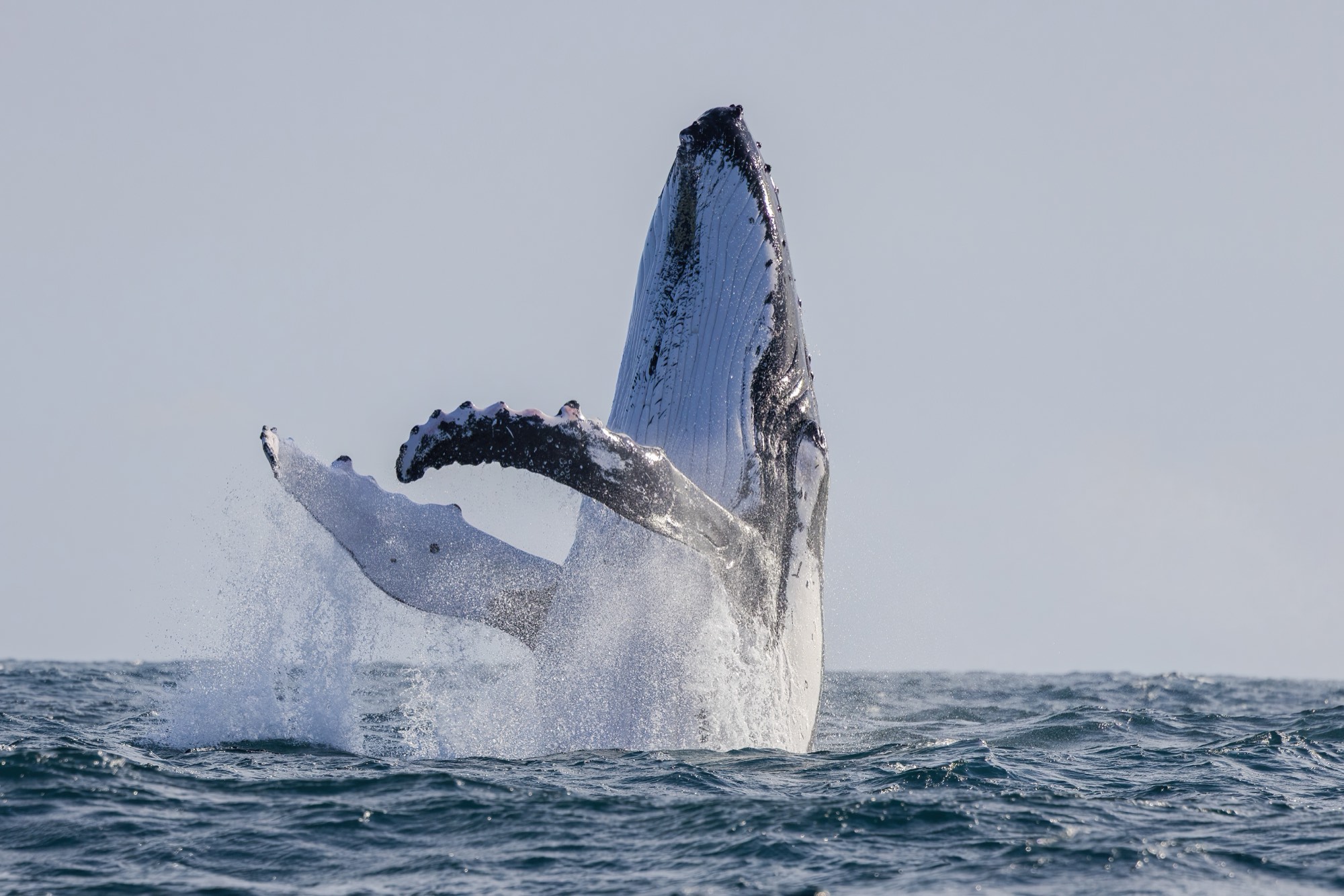
For centuries, we believed that fewer whales would mean more fish. The science tells a different story. The ocean, it turns out, runs on whales.
Overview
Whales are large animals at the top of the food chain, and they need to eat large quantities of food. So it is not surprising that they play an important role in the ecosystems in which they live. Because of the whales’ appetite, one could think that fewer whales would mean more fish for human fisheries. Industrial whaling, especially through the 19th and 20th centuries, removed an estimated 66–90% of large whales from the world's oceans. Some whale populations are growing, but total numbers and biomass are estimated to be around 15% of what they were before whaling began. So this should, in theory, equate to more marine resources available for fishing. The science, however, shows that this is not the case. Fewer whales do not mean more fish. Counterintuitively, ecosystems with fewer whales tend to be less productive overall — not more. The reason is that whales are ecosystem engineers. Ecosystem engineers are organisms that change, maintain or create habitats for themselves and other species by physically altering their surroundings. In a paper by Joe Roman, four key mechanisms of whales as ecosystem engineers were defined: 1) as prey, 2) as consumers, 3) as nutrient vectors and 4) through whale falls. We will explore these mechanisms in the following sections.
Whales as prey and consumers
Whales are large and filled with energy and nutrients in an environment where these resources can be otherwise hard to find. This makes them attractive as targets for predators. Their large size mostly keeps them safe, but they are a target of mammal-eating orcas. Many reports of attacks and evidence of scars on large whales indicate their role as prey. A potential example of the repercussions of the decline in large whale numbers can be found in the North Pacific Ocean. Here, one hypothesis claims that killer whales were forced to shift their diet to smaller marine mammals, like seals, sea lions and sea otters in response to fewer whales. This resulted in large decreases in these populations. The loss of sea otters especially impacted their environment. Sea otters eat sea urchins, which in turn eat kelp. With the lack of predation from the sea otters, the sea urchins could eat uninhibited. The result was a large decrease in kelp forests, which led to reduced primary production, fish populations and less marine carbon sequestration. A perfect example of how one element can quickly impact the whole ecosystem.
Whales also impact the marine communities heavily as consumers. In the North Pacific Ocean, it is estimated that about 65% of the ocean’s primary productivity was needed to sustain whale populations before commercial whaling began. Predation by whales may also impact the evolutionary dynamics of their prey. The whales might have been the driver of shorter lifespans and smaller size in copepods in the Arctic. Whales likely preferred larger copepods, which led the copepods to grow smaller to avoid the whales. Now that the whales are much less abundant in this area, the copepods grow larger and are longer lived. The whales are thus exerting a pressure that changes whole species’ lives.
Whales as nutrient vectors
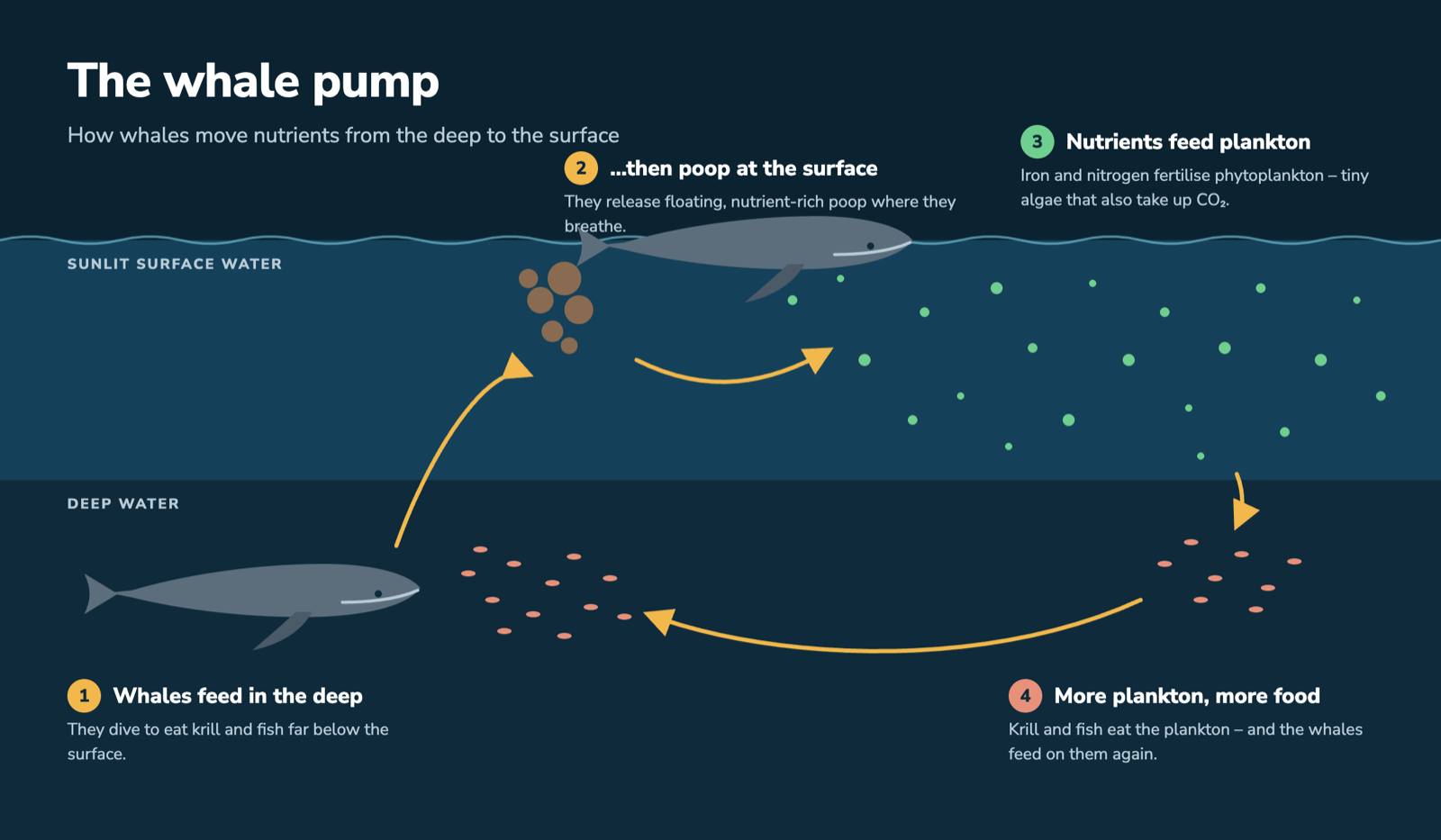
Whales move nutrients around the ocean in three different ways — and each one boosts primary production. Whales dive to feed and thus deliver mechanical energy to the water, which mixes the different zones of the ocean. The ocean consists of five distinct zones with very different characteristics due to, for example, sunlight levels and pressure levels. The uppermost zone is where primary production happens due to it having the highest levels of sunlight. Whales also contribute to the ocean’s productivity by bringing nutrients to the “sunlight zone” around the surface by defecating and urinating. This is known as “the whale pump” and likely plays a major role in boosting the primary production in these regions where nutrients are the limiting factor. Whales are also important nutrient vectors when migrating.
The great migrations of some whales are not only spectacular events, but also serve as important nutrient distribution. Whales move huge amounts of nutrients from nutrient-rich polar regions to nutrient-limited subtropical and tropical breeding regions. This is known as “the Great Whale Conveyor Belt”. The process is as follows: the whales feed in the prey-abundant cold waters, building up energy stores and blubber. When they are done feasting, they migrate to warmer waters to breed or give birth while fasting. To continue meeting energy demands, they metabolize their blubber, which releases nitrogen and other nutrients to the nutrient-poor warmer waters through urine, placentas and milk when lactating. According to a study in Nature Communications, four whale species - gray whale, humpback whale, North Atlantic right whale and Southern right whale transport roughly 46,500 tons of biomass, 4,900 tons of carbon and 3,800 tons of nitrogen.
Whale falls
When large whales die, they sustain the lives of many species. Usually, when a whale dies, it will float for a while, allowing seabirds and sharks to feed on it. After a while, the whale carcass sinks and falls to the ocean floor. Here, it provides a massive influx of energy and nutrients. The first thing that happens is called the “mobile-scavenger stage,” where sharks, hagfish and crabs consume the soft tissue. This comprises the first year or two. The second phase is called an “enrichment-opportunist stage” where worms, crustaceans and mollusks consume the organic matter in bones. The final phase is a “sulphophilic stage”, which might last for decades. The whale carcass now consists of only bone, which provides food for bacteria and zombie worms. They can eat the last fats and oils from the bones. Ultimately, this breaks down the skeleton and ends the whale carcass journey. The journey might feed abyssal organisms for a century. The skeleton can house more than 200 species during the final stage, and more than 60 species are fully dependent on whale falls.
So even in death, whales support life in the ocean.
The ocean absorbs about 31% of CO2 emissions, thus removing carbon from the atmosphere. This carbon would otherwise trap heat in the atmosphere and lead to higher temperatures. Mangroves and salt marshes are highly efficient at removing carbon from the atmosphere - they do it at a rate 10 times greater than tropical forests. Seagrass meadows cover 0.1% of the seafloor, but absorb 11% of organic carbon in the ocean. In spite of this incredible efficiency, about 7% of seagrass in the world is lost each year due to development, climate change and other things.
Whales store massive amounts of carbon in their bodies. Whales are very large and live long lives, which makes them very good at storing carbon, like trees in a rainforest. When whales die, they are consumed by deep-sea species that prevent the carbon from entering the atmosphere as CO2. A single whale might capture on average 33 tons of carbon dioxide over its entire life. An oak tree captures about 12 tons over its lifetime.
Whales also contribute through the whale pump. By excreting nutrients near the surface, they stimulate phytoplankton blooms. Marine phytoplankton captures the same amount of CO2 as four Amazon rainforests and produces half of the oxygen made by photosynthesis on Earth.
We can't yet put precise numbers on every contribution a whale makes to ocean health. But the more we measure, the clearer it becomes: in a world struggling with climate change and collapsing fisheries, whales may be among the most underrated allies we have.