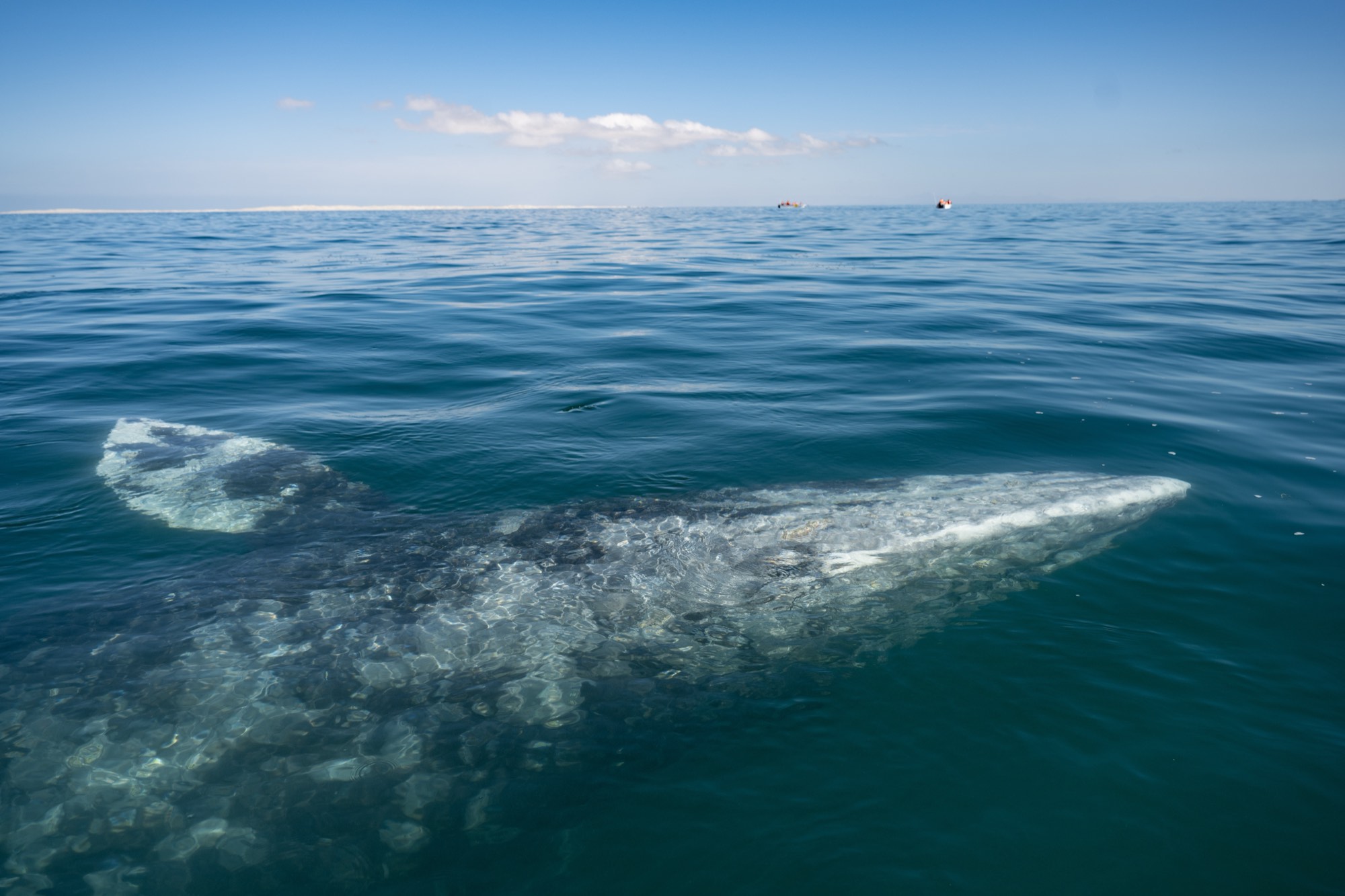
A humpback whale can hold a straight line across two thousand kilometers of open ocean — through currents, storms, and the deep dark — with the precision of a compass. We still don't know how.
Overview
Cetaceans are almost constantly moving to find food, mates, stay close to their group or escape predators. These movements can be both short and long and can take place in seconds or whole seasons. Foraging cetaceans face real challenges. In the oceans, the resources might not be evenly distributed. They vary seasonally and concentrate in specific areas. The animals likely know where these patches tend to form, and they forage in these patches. The patches drive much of the movements of cetaceans. The whales will search these patches for food, but if they don’t find high enough concentrations, they “commute” to another patch. These commutes — often hours or days between nearby patches — are part of everyday life for whales. “Ranging” is the search for patches between different regions. Different regions have different ecosystems and should provide new feeding opportunities.
Migration is the largest movement event and means that the animal makes regular, repeated and long movements between different locations. Whale migrations are some of the longest movements of any animal on Earth. The gray whale travels about 20,000 km on their annual migrations.
But why do they migrate? The truth is that it is not definitively known, but at least four theories exist. The first one suggests that it is because newborn whales need to keep warm, so baleen whales give birth in tropical waters. The second suggestion is that the whales track their prey to warmer waters. Some energetic models estimate that baleen whales need to feed when away from the feeding grounds as opposed to fasting, which some other theories suggest.
The third suggestion is that it is to avoid killer whales. Killer whales are less frequent in warmer waters, so this strategy might protect the calves at their most vulnerable stage. The fourth suggestion states that it might be an evolutionary holdover. The modern whales simply do it because ancient whales did it back when the environment was vastly different.
Most likely, the truth is some combination of all four — and one of the most exciting things about migration is that one of the most-studied behaviors in the largest animals on Earth remains, in fundamental ways, unexplained. Migration looks very different across cetacean species — baleen whales make some of the longest annual journeys on Earth, while many toothed whales follow more flexible, year-round movements.

Timing
Migratory whales mostly feed in summer and breed in winter, but how exactly do they time it every year to be there for the peak in prey abundance? One study by Angela R. Szesciorka sought to answer this by examining the migration timing of blue whales, environmental conditions, and prey abundance in the Southern California Region over 10 years. Productivity in this ecosystem is dependent on the seasonal upwelling of nutrients. The upwelling of nutrients leads to phytoplankton blooms, which lead to high abundances of zooplankton. Zooplankton are the blue whales’ food, so they are highly dependent on timing this phenomenon. The exact timing of this event varies from year to year and through larger climate cycles over several decades. The study correlates sea surface temperature of the past year with the timing of the blue whales the next year. When last year’s feeding season was in relatively cold water, the blue whales arrived earlier for the next feeding season. Likewise, when it was warmer, the blue whales arrived later the next season. The temperatures of the past year were also a good predictor of krill biomass the following year. So whales could tie the temperature directly to krill abundance.
The blue whales could maximize the high krill abundance by coming early or coming later if they don’t expect much prey. This reliance on sea surface temperature is also seen in leatherback sea turtles. The temperature reliance also means that memory would be important. They would need to remember past years’ conditions to inform the timing of the next year.
During the ten years the study tracked the blue whales, they found a trend. The arrival at the feeding grounds comes earlier. During the ten years, the mean annual sea surface temperature rose by one degree Celsius. This might be the reason that blue whales now arrive at the feeding grounds 42 days earlier while having the same departure time. That kind of shift, in just ten years, is a sign that whale behavior is already responding to climate change in measurable ways.
Straight routes
Baleen whales undertake enormous migrations from feeding grounds to breeding grounds and vice versa. Southern Hemisphere humpback whales travel distances of about 8300 km one-way. Gray whales travel longer than 11,000 km between Russia and Baja California, Mexico. Different species and populations have unique routes and usually return to the places they were shown as calves. A study by Travis W. Horton displays the incredible accuracy with which humpback whales navigate. When Horton and his team looked at the migrations, they identified long-distance constant-course track segments. This means that the humpbacks had segments of 240-2230 km of very precise navigation. The segments all fell within at least a 5° precision, and more than half had better than 1° precision. The segments lasted between 2 and 28 days, so they could hold their exact course for up to 28 days! For some of the whales, more than half of their migration followed such a straight trajectory, which suggests that these constant course movements are common to humpback whales.
What is equally impressive is their ability to adjust their heading. The study evaluated the sea-surface currents and found that they shifted the whale headings by about 1° to 25°. The tracks remained unchanged, however. So the whales were pushed off-line by currents, but they could precisely adjust and stay on their routes. This was done through the open ocean with almost no markers and in different depths of ocean, different bottom topography and even through a tropical storm!
How they achieve this incredible accuracy, we can only theorize about. The next section will look at some of the suggestions.
How do whales find their way?
The truth is that whales find their way around by a combination of several abilities. When traveling whole oceans, there is often not a lot to see. No big landmarks to navigate by, and the visibility is low anyway. Whales circumvent this by using a combination of senses to detect salinity and temperature of the water, seafloor features, currents and potentially scents. These features can reveal proximity to known places and known and trusted routes.
Another suggested mechanism is a sort of biological magnet. Magnetic material has been found in tissue near the brain of some whales. This could make them capable of feeling magnetic lines and their varying intensity, which should allow them to follow these lines and use them almost as a map. They might also have a compass by way of inclination, which is the angle at which the magnetic lines hit Earth. At the equator, the lines are parallel to Earth, while at the poles they go straight down. Whales might be able to detect this angle and thus know whether they are swimming towards the poles or the equator, kind of like a compass.
One piece of evidence supporting this theory is that during solar storms, which affect the magnetic field, increased strandings have been observed. This suggests that magnetism, at least, is a factor in whale navigation. However, whales experiencing different magnetic environments might still head in the same direction. Likewise, if they come from the same regions with similar magnetic characteristics, they often take different routes.
Other theories like celestial navigation and geographic cues likely play a part as well. How whales navigate so precisely is a mystery, but it is likely by a combination of several of these theories. Hopefully, one day we will find out for sure.
Whales are not the easiest study subjects. They travel enormous distances and spend most of their time underwater. The migrations of whales have become even more difficult over the past several years with melting ice and increasing underwater noise from humans. Studying migrations has therefore perhaps never been more important than it is now. One way to study migrations is from space. Whale Seeker is a startup from Canada that wants to use artificial intelligence (AI) for monitoring cetaceans. They can track migrations by using high-resolution satellite images and AI. The AI platform is trained to identify whales by body length and fin shape, among other features. Tracking and detection is much easier this way than having to do it by plane or boat. This method is still new and is being tested and developed, but could make future cetacean research much easier and faster. And in a warming, increasingly noisy ocean, faster and more accurate tracking of whale movements isn't just an academic improvement — it's the foundation for the kind of dynamic, real-time protections that migrating whales will increasingly need.