A son will spend his entire life beside his mother. A pod will mourn a lost calf for days. A fad — wearing a dead salmon as a hat — will sweep through a community and then quietly disappear. To know orcas is to realize how much of being alive isn't unique to us at all.
Recording: NOAA. Alfred Wegener Institute, Ilse Van Opzeeland. 2023. Killer Whale. NOAA Sounds of the Ocean
Ecotypes
Killer whales (Orcinus orca) are at the pinnacle of marine predators, hunting everything from fish to baleen whales. They are the largest species of dolphin and are found in every ocean. If you look at killer whales as a species, they eat a wide variety of prey - over 140 prey species have been found. However, if you look at populations, the picture changes dramatically. In the northeastern Pacific, you find three different ecotypes (populations of a species that have adapted to specific environmental conditions) with vastly different prey and hunting techniques despite overlapping ranges. Residents eat almost exclusively salmon, mostly one particular species: the Chinook salmon. Transients eat marine mammals, particularly seals and porpoises. And lastly, the offshores are thought to specialize in sharks and other fish. In most places where orcas are found, they exist in these specialized ecotypes, which when overlapping, don’t interact much. Very little breeding or cooperation is seen between ecotypes, and genetic studies show that ecotypes have been separated for many generations.
One study by Andrew D. Foote analysed genomic data from different ecotypes. The study shows that killer whale ecotypes were the result of a split from a common ancestor within the last 250,000 years. They, in evolutionary terms, rapidly created niches of different prey and hunting styles, which isolated the individual populations genetically. This created the big differences in orcas that we see today. A researcher named Lance Barrett-Lennard thinks this quick diversification is the result of three orca characteristics: they are picky eaters, xenophobic and show strong culture.
The last is culture — the behaviors and information that individuals learn from each other rather than inherit genetically. Orcas are quick learners and great imitators, and they learn directly from their mother, grandmother and sometimes other pod members. They are also quite conservative, which quickly creates distinct and somewhat rigid strategies. This all leads to the individualization of populations and thus distinct ecotypes.
Killer whale ecotypes
The table below shows the major ecotypes recognized so far. Research is ongoing and several populations remain to be formally described.
| Ecotype | Region | Primary prey | Distinctive features |
|---|---|---|---|
| Resident | Northeastern Pacific | Salmon (especially Chinook salmon) | Open saddle, dorsal fin has rounded tip with sharp angle at rear corner |
| Transient (Bigg's) | Northeastern Pacific | Small marine mammals, like seals and porpoises | Saddle patch large and gray, dorsal fin pointed |
| Offshore | Northeastern Pacific | Sharks and fish | Saddle patch solid gray or open, dorsal fin rounded, lacks sharp angle at rear corner |
| Type A (Antarctic) | Open areas of Southern Ocean | May specialize on Antarctic Minke whales | Large |
| Type B1 (Pack Ice) | Circumpolar | Pinnipeds | Large, gray and white form, dark cape pattern, very large eye patch |
| Type B2 (Gerlache) | Around Antarctic pensinsula, mostly in Gerlache Strait | Penguins and fish | Medium sized, gray and white form, dark cape pattern, large white eye patch |
| Type C (Ross Sea) | East Antarctica | Fish | Smallest ecotype, gray and white form, dark gray cape, narrow and slanted eye patch, may appear yellowish because of diatoms |
| Type D (Subantarctic) | Subantarctic waters | Unknown | Tiny eye patch, rounded head, dorsal fin pointy and swept back |
| Type 1 (North Atlantic) | Around Norway | Herring (some seen taking seals) | Relatively small, black and white, |
| Type 2 (North Atlantic) | North Atlantic | Most likely other whales | Black and white, backsloping white eye patch |
Dialects
Killer whales, like other toothed whales, produce echolocation clicks for foraging and mapping the world. They also make whistles, which are the kind of pure-tone whistles familiar from most other dolphins. The primary social sound orcas make is the discrete call. Discrete calls are short (1-2 seconds) tonal sounds. These discrete calls have different characteristics and may include quick frequency modulations, such as upsweeps and downsweeps. Orca family members are almost always within acoustic range of each other - their calls can be heard over many miles. The calls are very important for social cohesion and for keeping track of one another.
Killer whale populations all have their own calls, and these variations are called dialects. A scientist named John Ford pioneered this research in British Columbia and Washington State in the 1970’s and found distinct call types made by different sympatric (different populations living in the same area — what scientists call sympatric populations) populations. The Northern Residents were found to produce about 40 discrete calls, and the Southern Residents produced 26 calls. The organization of these acoustic groups can be divided into levels: clan level, pod level and matrilineal level.
The Northern Residents have three acoustic clans, whereas the Southern Residents have one. Different acoustic clans share no dialect features, so, for example, the Southern Residents have completely different calls from those of the Northern Residents. Clan-level calls appear to be remarkably stable — researchers have tracked them for over 50 years without seeing meaningful change. Resident pods have between 7 and 17 discrete calls each, and every member of the pod knows all the calls. Some calls are shared between pods, but some are unique to the individual pods. The same goes for matrilines. Researchers or frequent listeners can therefore tell the different pods or even matrilines apart based on their calls alone. Similarity in call types has proven to be a good measure of relatedness. The more acoustic similarities, the more closely related they are. It does not necessarily mean that they spend the most time together, however. On the matrilineal level, there are slow divergences over generations, eventually leading to new dialects.
Given the differences in these dialects between sympatric populations, it is a form of culture. The dialect is learned by the calf from the mother and other pod members, which makes it a cultural transmission. This is very rare in animals, and only a handful of other mammal groups, including primates, bats, and some pinnipeds, do it.
The function of the discrete calls is not fully known. Unlike many other animal calls, orca discrete calls don't seem to map neatly onto specific activities like hunting or traveling. Often, when an orca produces a call, it is met by the same call produced by other family members until they move on to the next call type. This call-matching behavior is one of the ways pods seem to maintain group cohesion across long distances. The emotional state is likely reflected in the call - for example, when excited, the pitch is usually higher and the duration shorter. Killer whales can probably communicate individual identity, pod identity, location and mood all through their discrete calls and unique usage of them. The calls, essentially serving as family badges, can be helpful when, for example finding a mate. Killer whales can tell the distance in relatedness and foreignness all by acoustics, which reduces the risk of inbreeding.
One call could be innate - the V4 call, which has been likened to laughing and is called the excitement call. In a study by Nicola Rehn, recordings from three ecotypes of killer whales were compared. The V4 call was found in every population, suggesting that this call is not socially learned, but might actually be more something like laughing in humans.
Hunting
Orcas are often called “wolves of the sea” because of their pack-hunting and ferocity. They employ a wide diversity of hunting techniques developed for their ecological niches. Orca populations are highly specialized and creative when it comes to hunting. For that reason, this section is split into three:
Pack ice type B1 killer whales wave-washing
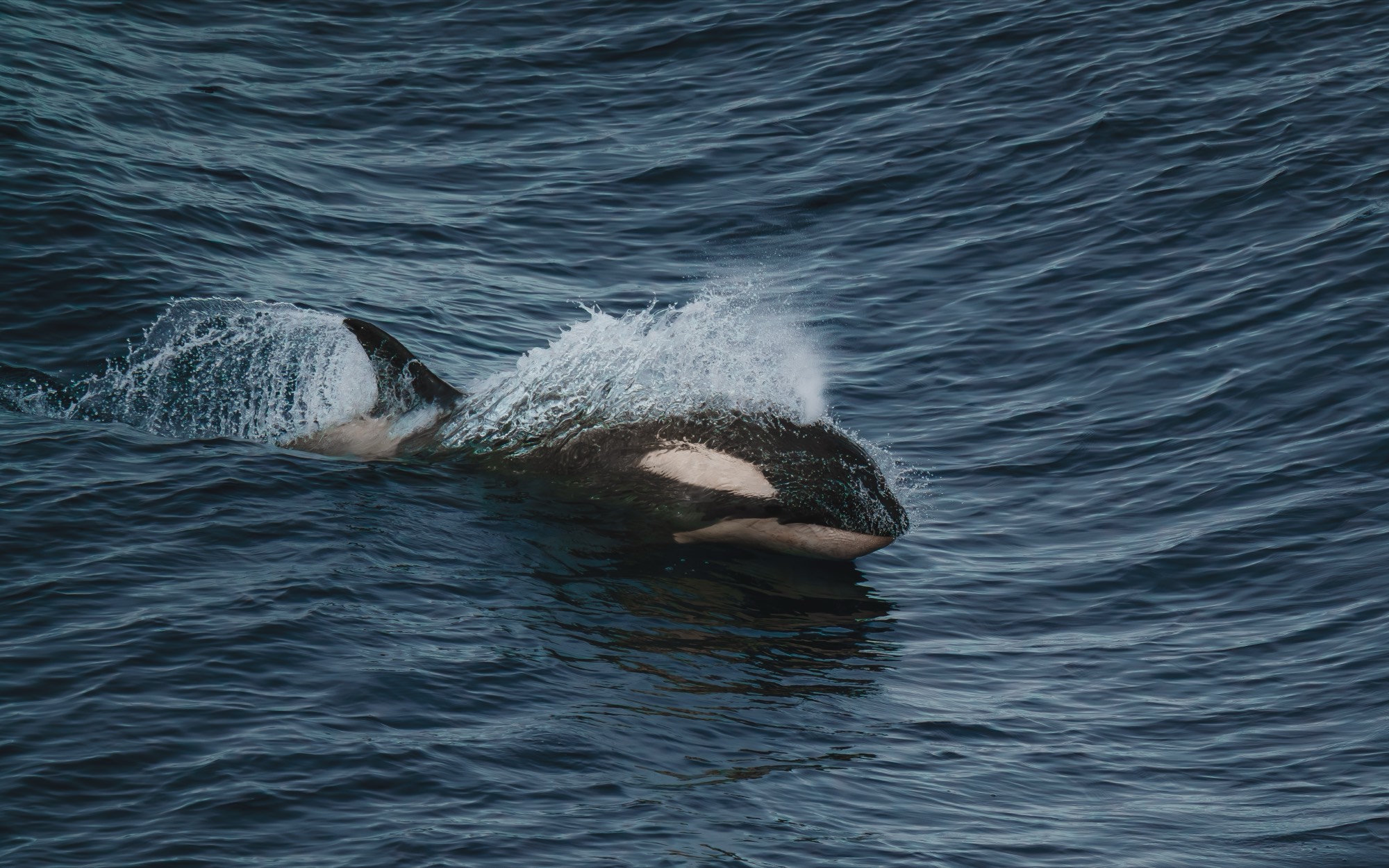
Antarctic Peninsula killer whales mostly hunt pinnipeds. To catch pinnipeds hauled out on ice floes, they create a wave to wash them off the ice. It starts with spyhopping to locate the pinniped. This is followed by bubble blowing and swimming around the ice floe. When at least 15 m away from the ice floe, the killer whales will group up and swim in a line towards the ice floe and thus creating a large wave, which might wash off the pinniped. The waves created can be either washing over the ice floe or under it. If it does not wash the pinniped off, it might break the ice floe into several pieces, which is all part of the strategy. The smaller pieces offer less protection, so they are slowly and steadily chipping away at the pinniped’s protection. It often takes multiple wave-washes (even 30) to dislodge the pinniped. The killer whales also push the ice floe into open waters free of other ice floes, where the pinniped could flee to. They even submerged quickly near the ice floe, thus making vortices, which also moved the ice and isolated the pinniped further.
This process is methodically repeated until the pinniped is caught. The technique has a very high success rate. This behavior requires great coordination and teamwork. It is not innate and must be taught by a mother or grandmother. The technique has been honed and perfected through many generations, and currently the type B1’s are the masters of it.
Intentional beaching
Orcas off Patagonia and the Crozet Archipelago have specialized in a very risky hunting technique of beaching themselves. Pinnipeds spend much of their time hauled out on land, and prey in the surrounding waters is scarce. So in Patagonia, killer whales patrol the beaches and learn the landscape to be able to follow deep-water channels right onto the beach. While patrolling, the whales go silent and keep their dorsal fins underwater to avoid alerting the pinnipeds. Once an orca spots a suitable target, it times a wave and accelerates rapidly, riding all the way onto the beach to surprise and catch an unaware pinniped. This requires a several ton fully aquatic animal to beach itself. They time the lunges onto shore with the tides to reduce the risk of stranding.
They return to the water by arching their heads and tails and rocking sideways.
It usually takes two to four incoming waves to refloat them. Off Patagonia, both males and females intentionally strand, but in the Crozet Archipelago, only females do it. The males are likely too big and stay in the deeper waters. This technique is very hard to learn, and young whales begin intentionally stranding at the age of 4-5 and are taught by adult females who show them how and help them get back to the water. Interestingly, it is not always the mother who is the teacher. It seems that they learn from the females who are best at this technique, thus outsourcing teaching, like going to school.
Carousel feeding
Carousel feeding is a highly coordinated and cooperative hunting style. It is used by killer whales on the northern coast of Norway to catch herring. Herring are fast and agile, and singly don’t make much of a meal for a killer whale. It is estimated that a killer whale needs to eat 285-578 herring a day, so chasing them one at a time is unfeasible. The orcas solve this by working together to herd, trap and immobilize the fish. Much of the time, the herring are found about 100 meters deep, so the first step is to swim around and beneath them, thus forcing them up. The surface acts as a barrier and helps trap the herring. Once trapped near the surface, the orcas continue swimming around the herring in a tight circle - the carousel. The orcas concentrate the herring into tighter and tighter “bait balls”. They do this by flashing their white bellies toward the herring and by blowing bubbles to scare the herring closer together. When the bait ball is sufficiently compressed, orcas take turns slapping the herring with their powerful tail flukes. The immense force stuns the herring, and orcas can simply pick them up and eat them. The rest of the pod maintains the perimeter. Like the other hunting techniques, this strategy is passed down through generations, and likely takes much practice for young whales to learn.
Tightknit families
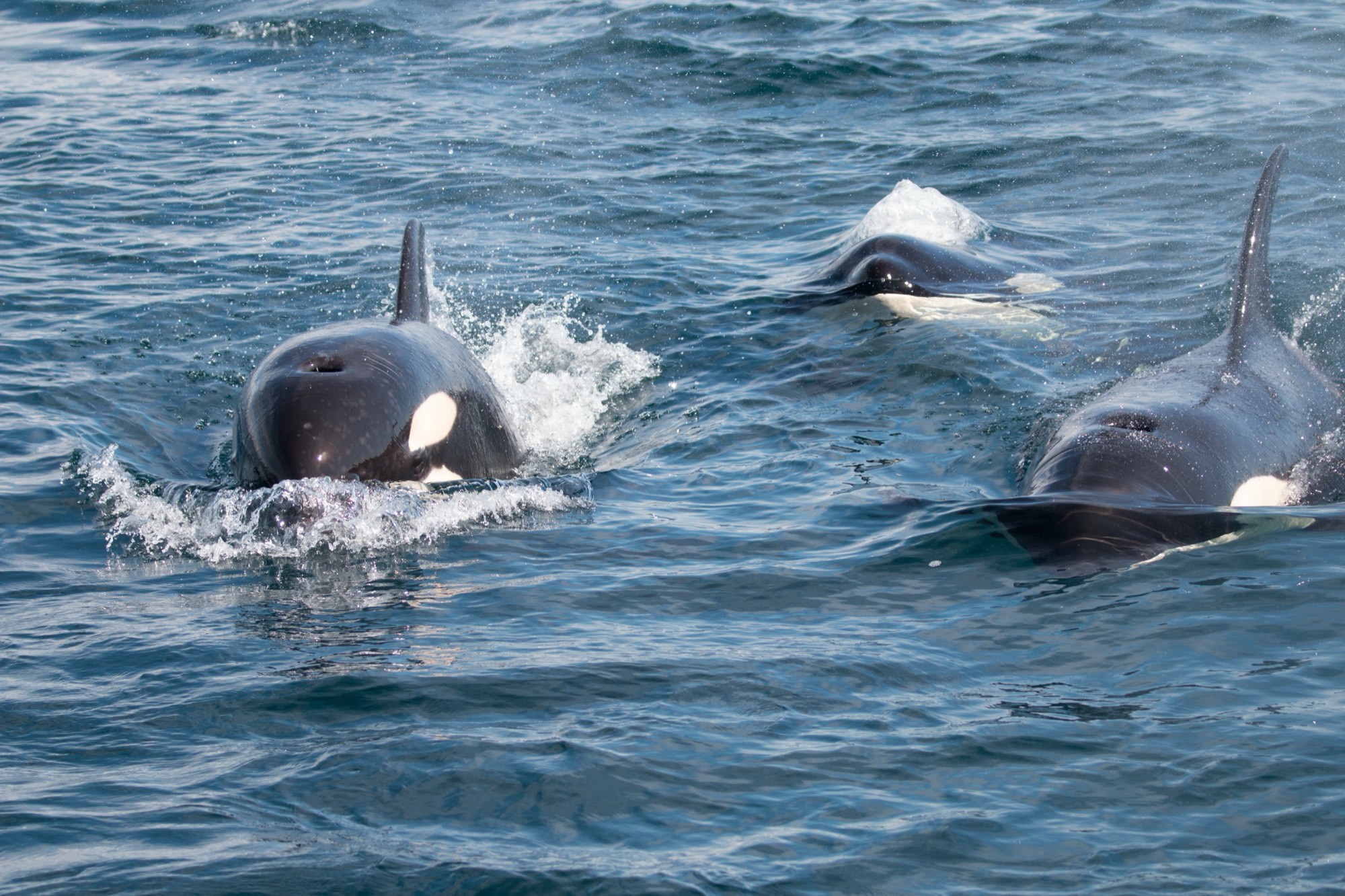
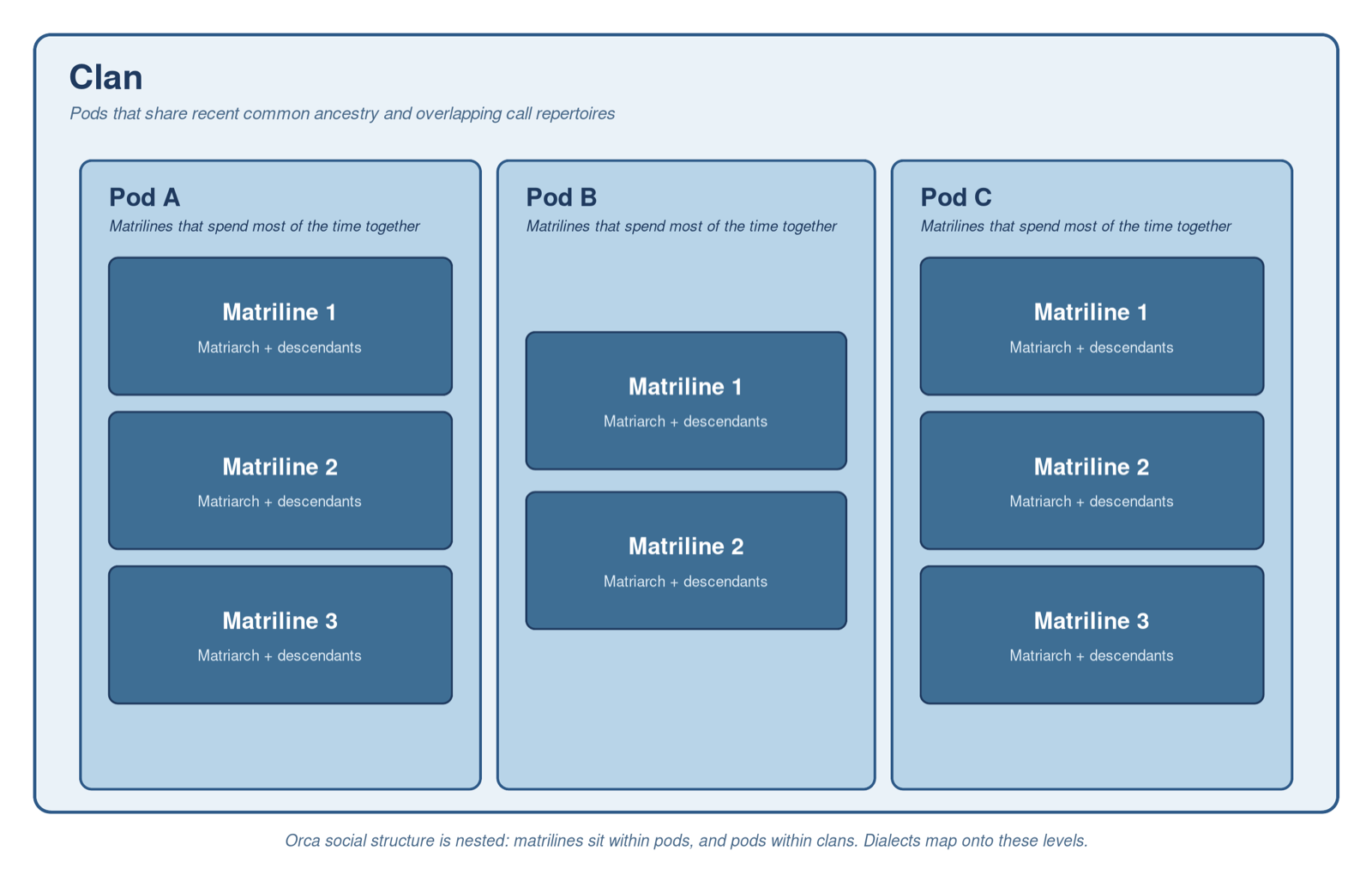
Orcas have some of the most complex and tightly knit family structures seen among animals. It is built around lifelong family bonds with whales in resident (fish-eating) populations, staying with their mothers for life. The heart of the orca social structure is the matriline. A matriline consists of a matriarch and her descendants — sometimes spanning as many as five generations. The unique feature of these matrilines is that both females and males remain in them for life - an arrangement almost unheard of in mammals. The matriarch keeps the family together, and the family follows her lead. The next level of organization is the pod, which is a group of matrilines that frequently travel together. Pods are closely related and tightly bonded. When pods come together, one unusual behavior has been observed in the southern residents. As they get closer to each other, the individual pods group up into tight groups, line up and face the other pod. Following this is diving and the joining of the two pods. They split into subgroups and play and socialize, making many vocalizations. This behavior has been called a “greeting ceremony”.
The next level of organization is the clan. The clan is made up of pods with similar dialects and likely stems from a common ancestral pod. The top level is the community, which is pods that have been seen associating. For example, the northern and southern residents in British Columbia and Washington State are two communities, because they have never been seen doing anything together. One advantage that group-living provides the killer whales with is the wealth of information it contains. In the areas of the resident populations, the primary food is salmon, which have complex life cycles. The five salmon species all have varying timelines and return to different rivers. The exact location in these rivers even varies due to seasonal differences in water levels. So the exact place to intercept them, potentially tens of millions of salmon, is very hard to know. It likely takes many years to learn, so having older and more knowledgeable family members to show you how it is done is very valuable. Killer whales are one of the very few animals that undergo menopause - some of the others are other toothed whales like short-finned pilot whales and beluga whales. Orcas live up to several decades after they stop reproducing, because they hold the collective memory of the pod. Older females also take a larger role in the lives of their offspring and grandoffspring, thus boosting the pod’s overall fitness.
The information so far has been centered around fish-eating populations, but the picture changes a bit when discussing the mammal-eating populations. The mammal-eating killer whales hunt very different prey and so prioritize stealth, speed and teamwork. The biggest difference is the size of the groups. Bigg’s killer whales (mammal-eating) travel in groups of usually 1-5. This is largely due to the need for stealth. Marine mammals have good hearing, so they would easily hear larger groups of killer whales approaching. This is also the reason for their much quieter nature than fish-eating populations. A smaller pack also means more food per prey, which means that every member gets enough food to outweigh the energy expenditure of the hunt. With larger prey (like whales, for example) they may group up with other matrilines. Unlike resident orcas, transient family structure is somewhat fluid. The matriline still forms the core, but when the family grows, the younger generations will split off to form their own matrilines. Often, when a female has her first calf, she will form her own matriline. Males may stay with their mother for life or live and hunt alone, whilst only temporarily teaming up with other lone males. Bigg's social structure is shaped by completely different pressures, but it's no less specialized — it's a system optimized for stealth and surprise rather than knowledge-sharing.
| Feature | Resident Orcas | Transient (Bigg's) Orcas |
|---|---|---|
| Primary Diet | Fish (mostly Salmon) | Marine Mammals (Seals, Whales) |
| Typical Pod Size | Large (10 to 50+ individuals) | Small (1 to 5 individuals) |
| Lifelong Bond | Absolute; offspring never leave | Flexible; offspring disperse as group grows |
| Acoustic Style | Chatty, vocal, distinct pod dialects | Mostly silent; vocalize only after a kill |
Orcas are very intelligent animals and in this “dig deeper” we will take a look at two unusual behaviors.
The salmon hat fad
Back in 1987, a female from K-Pod of the southern residents was seen swimming around with a dead salmon on her forehead. This behavior was soon copied by others, and within five to six weeks, the neighbors of J-Pod and L-Pod were also seen wearing the salmon. The behavior does not seem to serve any survival or evolutionary purposes. It is most likened to a fad. By the end of the season, the fad died out and was not seen again until 2024. A male orca named J27 (or “Blackberry”) was seen swimming around with a salmon on his head. It did not start a trend this time, however.
The story of Twofold Bay
Humans cooperating with wild animals is rarely seen and has only been documented with a few species. It requires a great deal of social learning from both the animals and humans to succeed in this endeavor. One such relationship was recorded in Twofold Bay, Australia, back in 1844. Orcas and humans hunted baleen whales together for almost a century. The orcas would herd the baleen whales into the bay and alert the humans by slapping and splashing with their tail flukes in front of the whale station. The orcas herded and tired out the baleen whales by biting and trying to drown them by covering their blowholes. Once tired, the whalers could kill the baleen whale. The killer whales would then eat the tongue and lips, while the whalers could have the rest. That way, it was a deal that benefited both. Especially one whale, named Old Tom, was active in this effort. He helped pull the tow rope at the beginning of the chase and slowed down the prey by pulling the harpoon line in his mouth by the end.
In the end, a non-local European murdered a beached orca, which was seen by the other orcas and Aboriginal whalers. The Aboriginals left Twofold Bay angered, and the orcas seemingly did the same. Only a few orcas (including Old Tom) returned, and while they continued to some degree to cooperate, the practice died about 15 years later.