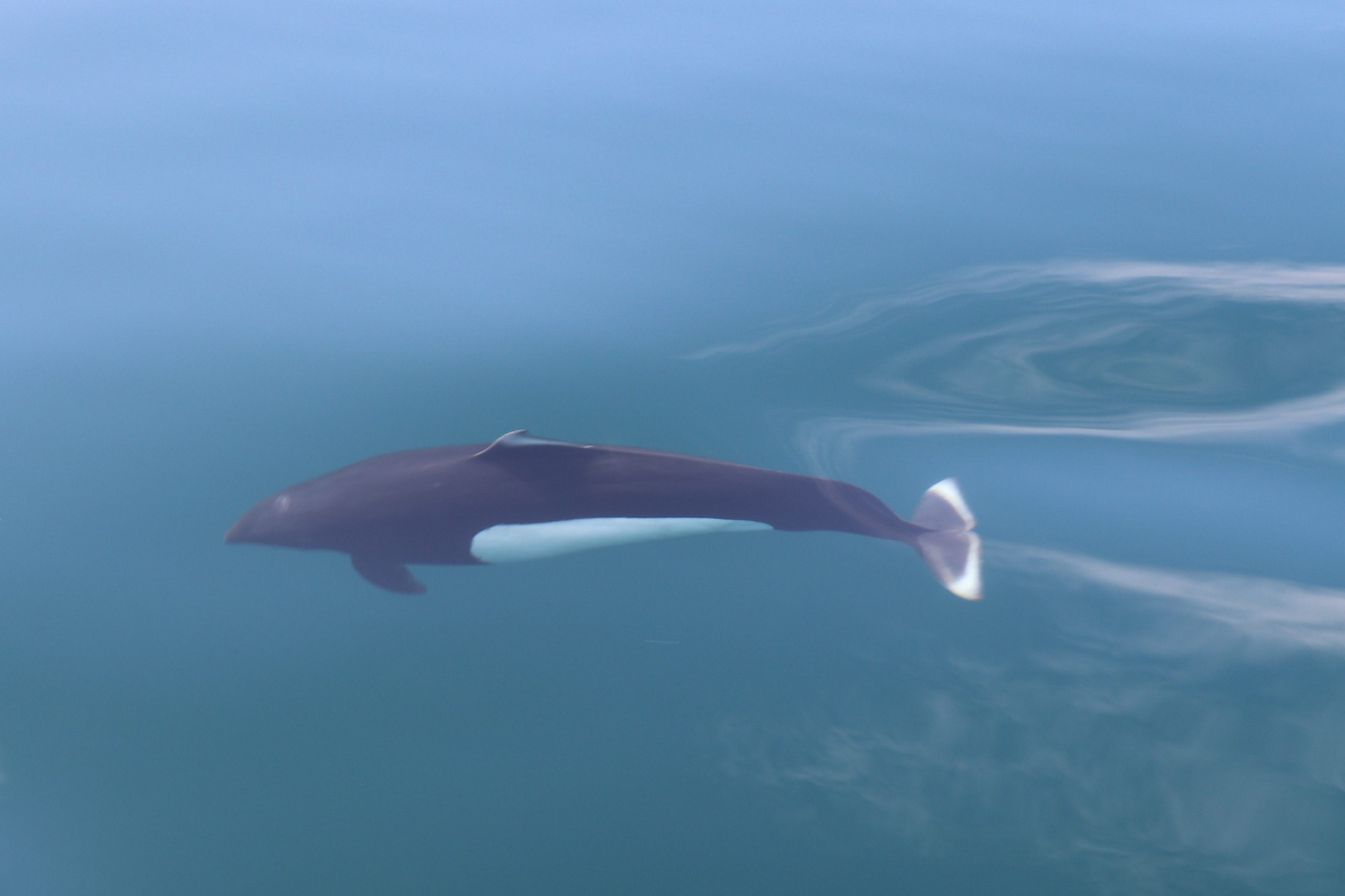
If you were to watch a group of harbor porpoises from a boat, you might conclude that they barely interact. They surface briefly, scatter, and disappear. For a long time, scientists thought the same. Then they started listening.
Recording: NOAA. Scottish Association for Marine Science, Denise Risch. 2023. Harbor Porpoise. NOAA Sounds of the Ocean
Porpoises - overview
There are seven porpoise species, and they belong to the family Phocoenidae. Porpoises are generally not very big - all are below 250cm in length. They lack the beak common to many delphinids. This lack of a beak and their rounded heads can make them look like juvenile dolphins. Porpoises are smaller than most other toothed whales, and that sets them apart. They need to deal with certain aspects of life differently from their larger counterparts. For example, it has been shown that harbor porpoises have about 40% higher field metabolic rates than similar-sized terrestrial mammals. This is likely due to their high surface-to-volume ratio, which generally makes it harder for small animals to keep warm in cold waters. For the same reason, they need to feed more often and especially before winter to build up the blubber layers. It is likely also to keep warm that they have developed relatively smaller appendages than other toothed whales.
Another way they differ from the larger toothed whales is in their reproductive pattern. Porpoises also march to a different biological clock than their larger relatives. Where a sperm whale takes years to mature and may live for decades, a harbor porpoise is sexually mature at just a few years old and rarely survives past its mid-teens.
Social lives
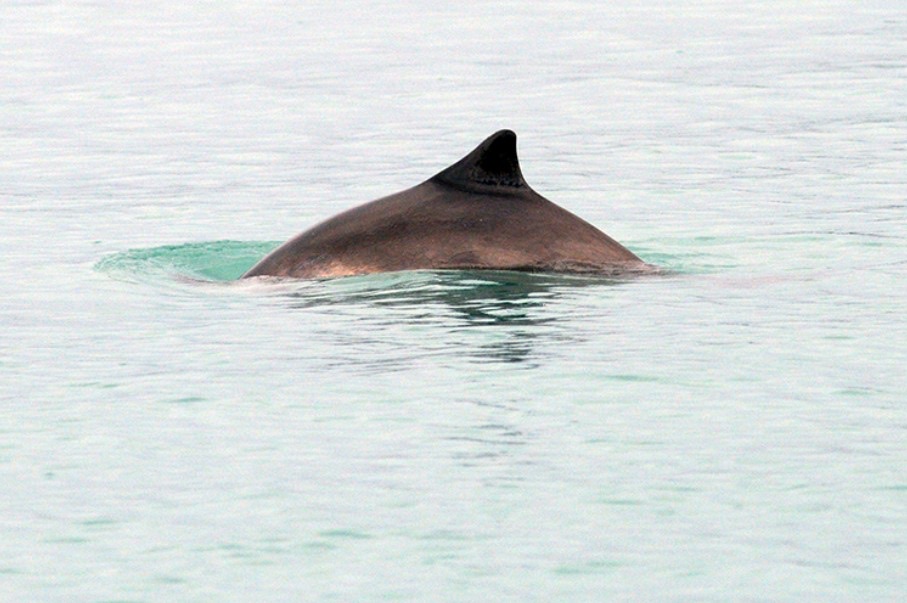
Porpoises are generally found alone or in small groups. When in groups, the organization is that of a fission-fusion society with very dynamic relationships, like those commonly seen in bottlenose dolphins. The only stable long-term relationships in porpoises are generally between mother and calf during lactation. However, a study by Mai Sakai found that finless porpoises synchronize dives with a chosen social partner. This means that at least some individual porpoises form associations outside that of mother and calf.
It happens that large aggregations of hundreds of porpoises appear, but these large groups are not stable and don’t last for long.
The social lives of porpoises, when compared with dolphins, seem much quieter and more isolated. It might be that the sociality of porpoises is simply more subtle, however. A 2018 tagging study discovered frequent high-repetition-rate click series that were often shared between nearby porpoises, which could be more important to them than being physically close, as can be monitored easily by humans. A 2019 study by J. Teilmann and S. Sveegaard suggests that harbor porpoises are more social than we give them credit for. Acoustic contact between mother and calf is kept up 58% of the time, and 36% between lone porpoises.
Foraging in harbor porpoises
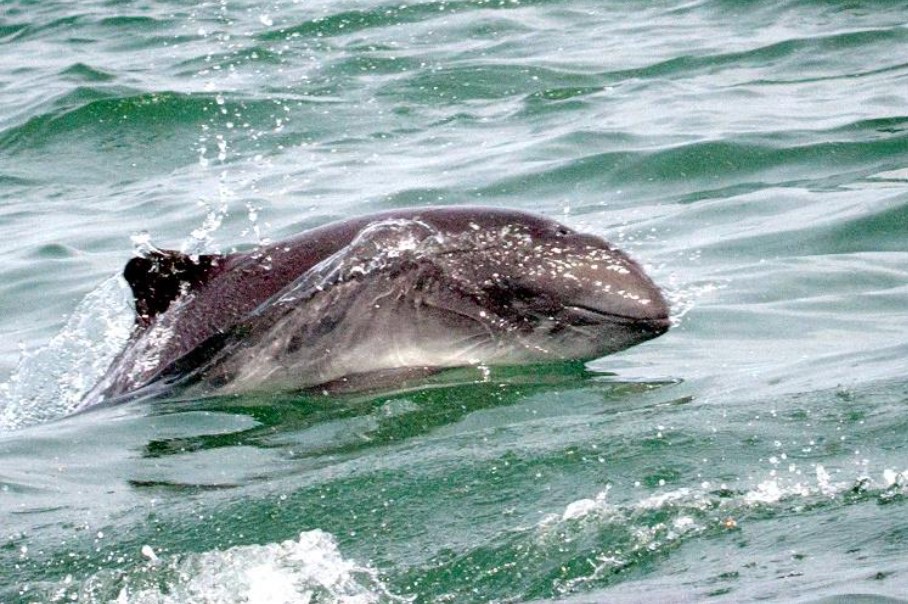
How the porpoise forages, what it eats and its prey capture rates are all important for determining its role in the ecosystem. Harbor porpoises require a lot of food (about 10% of body weight daily) to keep warm in the cold waters they inhabit. Harbor porpoises use echolocation to map their environment and locate prey. When looking for prey, they emit fewer clicks and direct their echolocating beam in different directions. When prey is found, they focus on that and as the porpoise gets closer, it emits rapid click sequences with more than 500 clicks per second until catching the prey. A study by Danuta Maria Wisniewska equipped five harbor porpoises with high-resolution sound and movement recording digital tags (DTAGs). She and her team found that the number of rapid click sequences for harbor porpoises is approximately an order of magnitude higher than those for larger species, like sperm whales, beaked whales and pilot whales. This reflects a much more active forager in the porpoise. It likely also shows a very different strategy. The tagged porpoises foraged day and night and went after small prey (3-10 cm) and had a capture rate of about 90%.
This constant foraging and high metabolic needs make them vulnerable to even small changes in the environment. Even a small decrease in capture rates may be of great importance to the fitness of the porpoises. Porpoises have been reported to starve to death in about a week.
POPs from mother to calf
Many persistent organic pollutants (POPs) have been banned for many years now. These chemicals, which include polychlorinated biphenyls (PCBs) and pesticides, are still very much present in our marine ecosystems. POPs affect reproduction, the immune system and the hormonal system. A study by van den Heuvel-Greve in 2021 analyzed samples from 121 stranded harbor porpoises for contaminant levels. Immune system disruption happens at 9 mg/kg lipid weight of PCBs, so that was set as the threshold level. Almost 40% of harbor porpoises had higher concentrations than the threshold. More than half of the newborn harbor porpoises had PCB levels surpassing the threshold. Since PCBs accumulate in the blubber, which is used by the mother to make milk, the PCBs are transferred to the calf through the milk. Some contamination also happens through the placenta during pregnancy.
Females can offload part of their contamination to their calves, but males have no way to get rid of it, so it keeps building up throughout their lives. Because males are not able to transfer part of their contamination, over 90% of the adult males had PCB concentrations higher than 9mg/kg. Only 10.5% of females exceeded the threshold.
The effective conservation of a species requires knowing how many animals there are. If you count the animals repeatedly, you can track trends and these lead to conservation actions. You again need abundance estimates to track whether the conservation efforts are effective. Simply knowing how many animals there are is quite tricky, however. Many techniques for estimating abundance have been developed, but one of the most effective is passive acoustic monitoring. It is based on detecting species-specific sounds and using those for abundance estimation. A study by Mats Amundin and Julia Carlström used this technique to estimate the abundance of harbor porpoises in the Baltic Sea, where the populations are declining rapidly. The almost constant vocalizing from the harbor porpoises in a frequency band where ambient noise is low makes them ideal for this method.
The survey used almost 300 acoustic data loggers placed in waters between 5 and 80 m deep. They estimated an abundance of 71-1105 porpoises, which places the critically endangered harbor porpoises in the Baltic Proper at risk of extinction. The wide confidence interval reflects how difficult it is to count animals in vast, murky waters — but even the upper estimate is alarmingly small.