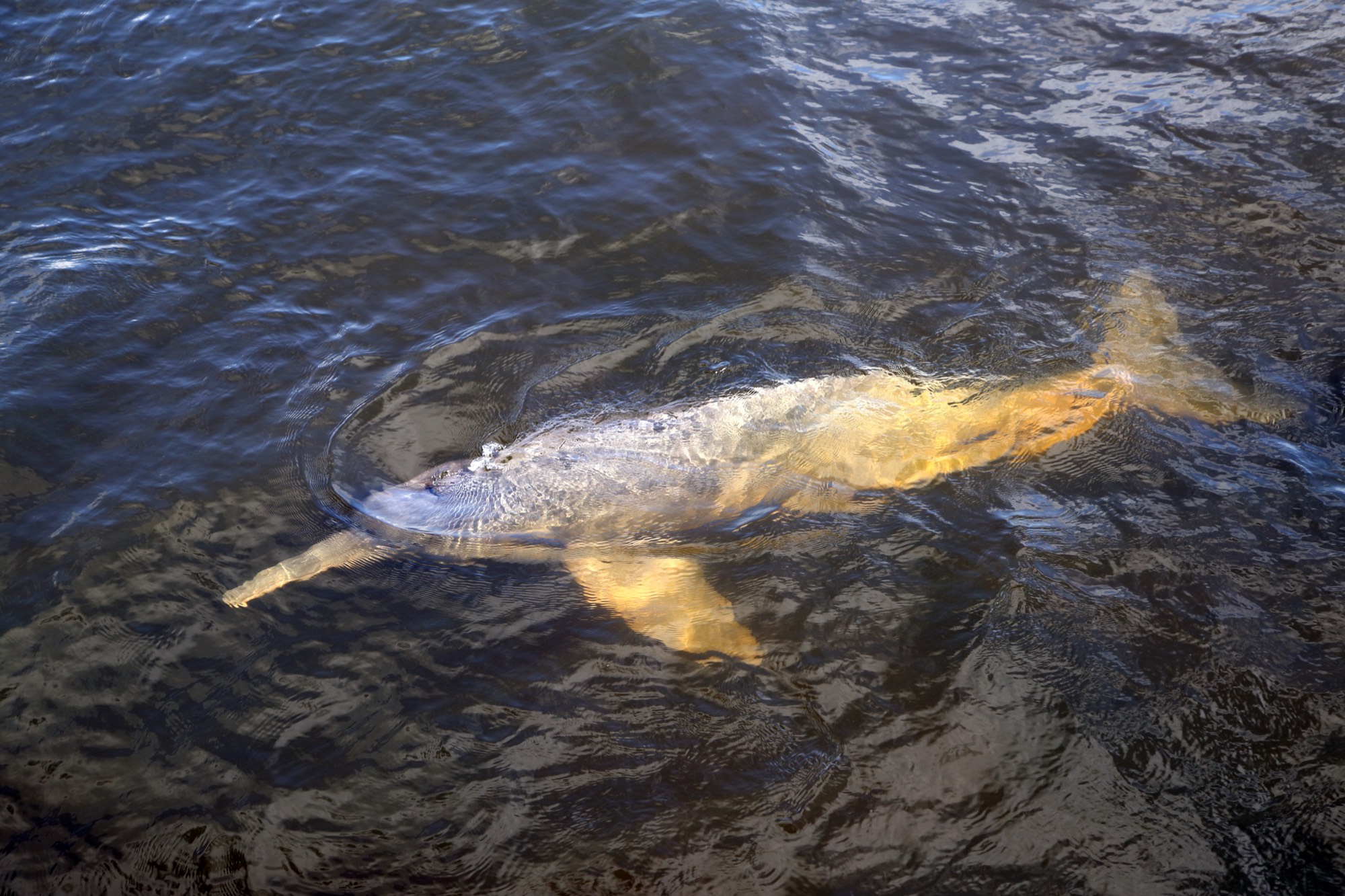
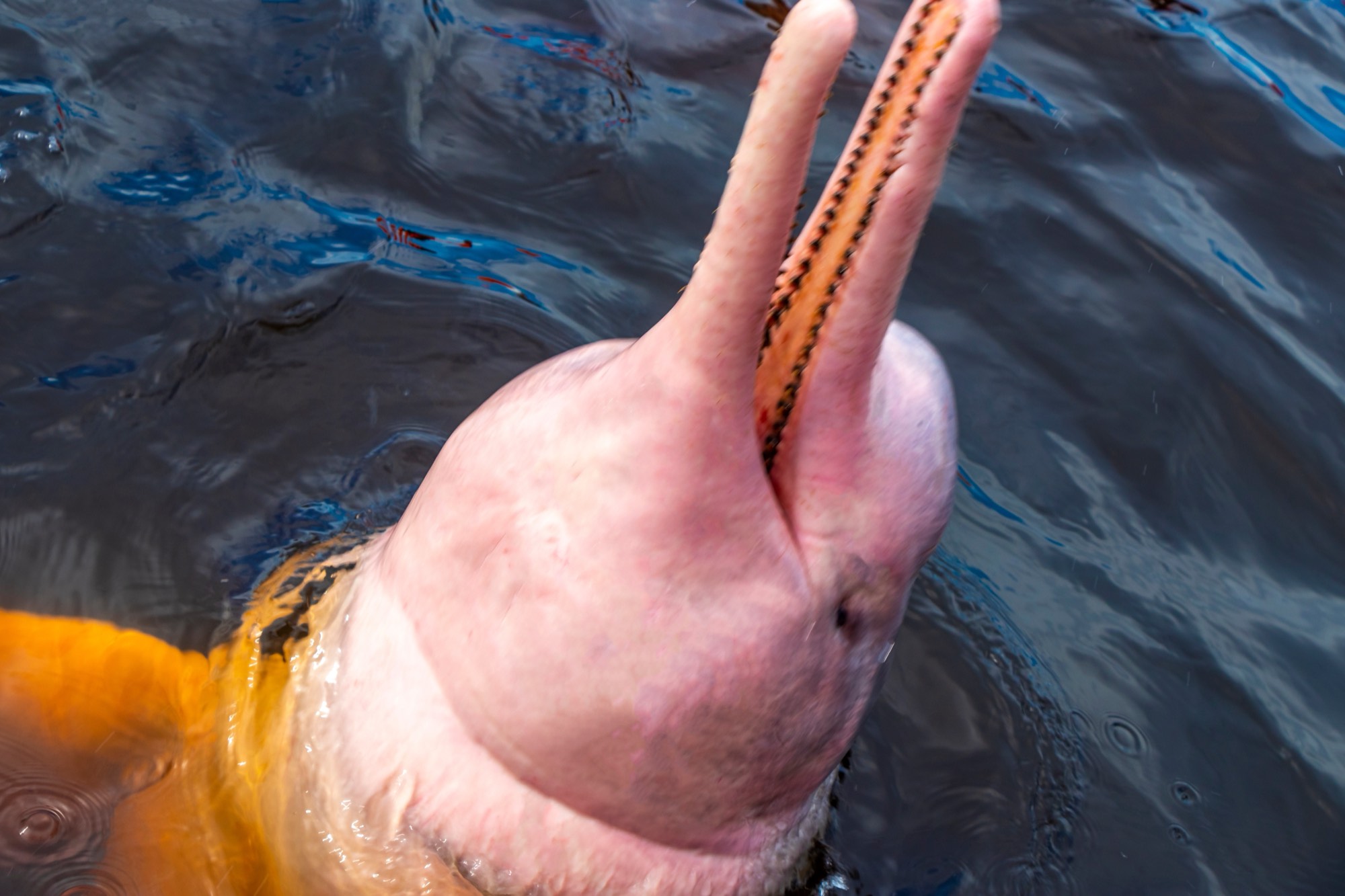
In villages along the Amazon, a child born without a known father is called a 'child of the boto.' The boto — the Amazon river dolphin — is said to take human form at night, charming women before slipping back into the river before dawn. It is a legend, of course. But it tells you something real: these animals have lived alongside humans for so long, and so intimately, that they have become woven into the fabric of human culture.
River dolphins - overview
Depending on how they’re classified, there are four to six species of river dolphins, and almost all are endangered ir critically endangered. River dolphins inhabit freshwater rivers in Asia and South America. The environments they inhabit change rapidly, so they are highly adaptable. The water levels in the Amazon can vary by as much as 13 m across the seasons. This leads to great variance in the habitats they can occupy seasonally. When the water is low, they must stay in deep channels, but in the flood season, they can enter rainforests and grasslands as well. These smaller and more maneuver-heavy habitats have made river dolphins agile, with large flippers and flexible bodies. One river dolphin, the boto, can actually swim backwards.
The vision in these habitats varies, with some places being quite clear and others almost completely dark. Because of the often murky waters, river dolphins don’t rely much on vision and most have small eyes - the Indus and Ganges river dolphins are essentially blind, only being able to tell large differences in light level. All river dolphins have a highly developed biosonar and use this to forage both day and night. They have quite a diverse diet filled with mostly different species of fish, but also crabs and turtles.
Risks
All river dolphins face large risks with habitats so close to humans. The baiji from the Yangtze River has recently gone extinct. The reasons the baiji went extinct are largely the same reasons the remaining river dolphins are at such risk. Baijis were likely hunted until they got protection in the 1980’s. From then on, the risks included getting caught in fishing gear, being struck by ships, exposure to explosives from construction, overfishing, pollution, underwater noise and damming. The protections afforded to the baiji were not enough, and these same risks are being faced by today’s river dolphins.
Conservation and coexistence
Human use of a freshwater area tends to work against the conservation of biodiversity. Fisheries in the areas of river dolphins provide substantial economic benefits to the locals. It is, however, often overexploited and in competition with local wildlife, such as dolphins. A study published by Conservation Biology looked at the competition between local fisheries and Ganges river dolphins in India. The purpose was to find out whether the two could coexist. The dolphins’ use of the main channel increased markedly in the dry season, likely because of the drying of tributaries. The dolphins preferred the same waters as the fishermen, with a preference for moderately fished (2-6 boats per km) areas as opposed to the heavily fished (8-55 boats per km). The estimated prey-resource overlap was 75%, which indicates heavy competition.
Possible solutions presented in the study were to regulate fishing in areas the dolphins prefer, which would decrease the competition. The dry season flows in tributaries could also be maintained, which could keep the dolphins in the less fished tributaries and thereby reduce competition in the main river.
Mythology - river dolphins
The lives of humans and river dolphins have been intertwined for many years due to the shared habitat. The river dolphins have become a large part of human culture in these areas, and they are included in many stories.
One of the most famous legends is from the Amazon and involves a shapeshifting boto. The legend tells of the boto turning into a handsome man at night. This man then seduces and charms the women of the villages. He impregnates them and returns to the river before sunrise. In the Brazilian Amazon, a child without a father is still called a “child of the boto”.
Another legend about the boto is about the underwater city of Encante. This legend warns about the boto (sometimes in human form), which will take lone swimmers to the underwater world of Encante. When taken to Encante, they can never return. The world of Encante is a paradise, but this story was told to warn children against swimming alone.
The next legend is about the now extinct baiji. Once upon a time, on the banks of the river Yangtze lived a beautiful girl. She lived with her stepfather, who was evil and greedy. The stepfather one day took her out on a boat, with the intent of selling her. However, while on the river, he was overcome by her beauty and wanted her himself. She escaped him by jumping into the river, at which time a huge storm came and sank the boat. When the storm settled, a beautiful dolphin was seen swimming. The dolphin was the incarnation of the girl and became known as the “Goddess of the Yangtze”.
Many cultures have stories like these, and hold dolphins sacred. The boto is considered sacred by indigenous Amazonians, and if you kill one or eat one, you will be followed by bad luck.
Playing is something hard to exactly define, but when we see it, we know it. Playing is seen among many animals, but the most complex forms are usually performed by mammals. Cetaceans, and especially dolphins, are famous for their playful behavior of jumps and spins in the air, along with bow-riding. The Bolivian river dolphin lives in the Bolivian Amazonia and has been reported to be playing with a Beni anaconda. The Beni anaconda is a boa species that grows to around 2-4 m long. Two male Bolivian river dolphins were seen with the Beni anaconda in their mouths for seven minutes. This was the first time any interaction between the two species had been observed. The reason for the interaction is unknown, but the team behind the finding believes that it was play on the part of the dolphins. Both dolphins also had erect penises, which is indicative of play and perhaps sexual stimulation of some kind. Younger dolphins were also around, so perhaps the adults were displaying a hunting technique. We don’t know the reason behind this, but it is unlikely to be predatory, because these snakes have not been reported to be eaten.