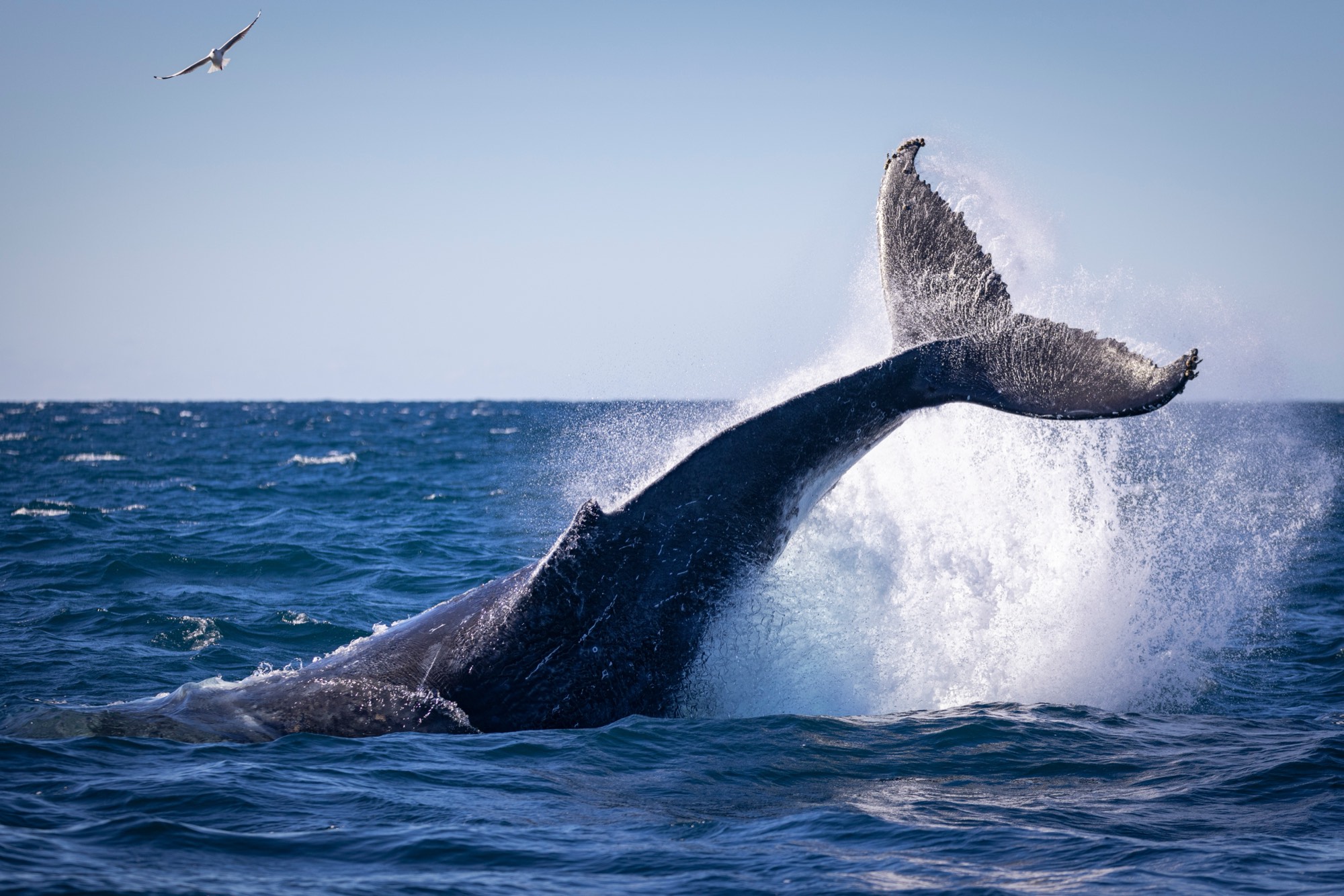
Bigger than any dinosaur, yet powered by tiny krill. How does the blue whale survive as the ultimate giant of the oceans?
Recording: NOAA. Cornell University, Cornell Lab of Ornithology, K. Lisa Yang Center for Conservation Bioacoustics. 2023. Blue Whale. NOAA Sounds of the Ocean
Overview
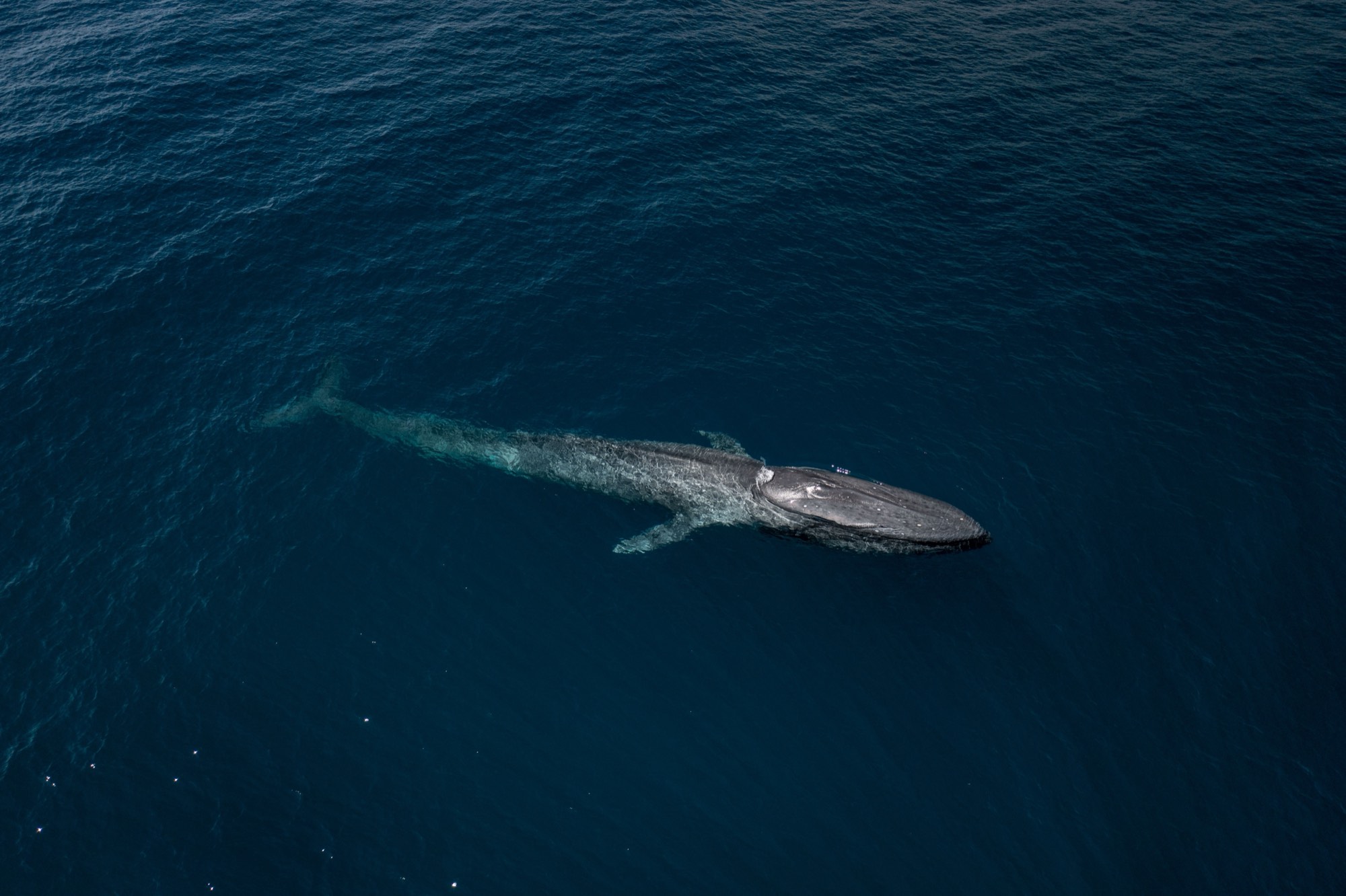
Blue whales (Balaenoptera musculus) are the largest animals to ever inhabit Earth. They can grow up to 32 m long and weigh somewhere between 50 and 170 tons. Blue whales are actually a mottled blend of light and dark shades of gray, but underwater the color turns blue. Individual whales can be identified because of the unique mottling of their skin.
Currently, five subspecies have been designated. The largest are found in the Southern Hemisphere, and the smallest of the subspecies is called the pygmy blue whale. Despite heavy whaling exploitation, the blue whale is still found in all oceans, but rarely in the high Arctic. They feed almost exclusively on krill and face little predation pressure. In the Gulf of California, 25% of blue whales photo-identified showed scarring resembling the rakes made by killer whale teeth. It is unlikely that the killer whales have much success in these attacks, and mortality once grown is likely low. Blue whales live long lives of at least 80-90 years. They are mostly found alone or in pairs, with larger aggregations only happening around large feeding sites. Mating is still mostly unknown territory, but female-male pairs have been found lasting up to as much as five weeks.
Migrations happen across ocean basins with alternating breeding and feeding seasons. They are well built for migrations with their large and streamlined bodies perfect for efficient swimming. In spite of their gigantic size, they can travel at speeds between 7-20 km/hr and reach speeds as high as 35 km/hr.
Powering massive bodies
Blue whales are filter feeders able to engulf massive amounts of water and krill in one go. But in order to do this, they need to first find the krill. Krill are very abundant but are also highly concentrated in patches, which can be hard to find in the offshore environment of blue whales. One theory suggests that they use their long-term memories to track ocean productivity. Krill aggregate in the most productive areas of the ocean; blue whales are therefore often found around cold current upwellings. When closer to the krill patches, they most likely use their eyes to lock in on the target.
Once the target is found, they lunge feed. Often, lunge feeding starts below the krill patch with the whale accelerating up to speeds of 4m/s. The lower jaw opens to nearly 90 degrees, and the ventral groove tissue allows the mouth cavity to expand enormously. The volume of water and prey combined is larger than its body. The whale slows markedly once the mouth opens, given the high drag. Now it is time to close the mouth and expel the water. The water is pushed out, and the baleen traps the krill. This takes about 40-60 seconds. Dives last 8-15 minutes and often contain four lunges. Given that this method takes repeated accelerations, it is energetically costly. However, because of the huge amounts of prey consumed, it is still a very effective feeding strategy.
Long-distance communication
Baleen whale vocalizations are low frequency and mostly 1-30 seconds in duration. The blue whale makes sounds (called moans) at a frequency of 20Hz and can be detected from more than a thousand km away. They can be as loud as 189 dB! These sounds, with their low frequency and long wavelengths, are well suited for long-distance communication, as low-frequency sounds travel farther. It is thus likely that these sounds are produced for communication purposes. They have been connected to behaviors such as assembly calls, long-range contact, sexual advertisement, greeting and aggression. Exactly what the purpose is remains unresolved. It is very hard to couple sounds to behavior because we usually can’t see the whales while they produce the sounds. Blue whales have distinct call repertoires that vary between populations. The northeastern Pacific blue whale has four call types.: A, B, C, and D calls. These calls are distinct and all have their own frequencies and upswings and downswings. A, B, and C are often made together, with A the most frequent starting point. It is the B calls that produce sound levels up to 190 dB. Globally, blue whale songs consist of at least 10 types. The song structures remain stable over decades. In historical recordings from 1960, the frequencies were examined and compared to present songs. 7 of the 10 songs showed a downward shift in frequency. Some possible explanations for this are increased human-made noise and sexual selection.
Threats facing blue whales
Blue whales are with their large size, mostly protected from predators. The same large size also means great commercial interests. Blue whales were favorite targets of whalers from the late 1800s to 1966, when they got worldwide protection from the IWC. During 1900-1950 325.000-360.000 blue whales were killed in the Antarctic. From 1930-31 30.000 were killed in this year alone. This huge pressure from whaling resulted in the near extinction of blue whales. It is now listed as Endangered by the IUCN. The Antarctic subspecies is critically endangered because the current population is estimated at less than 2% of its pre-whaling size.
Threats facing them now include ship strikes, acoustic disturbance and changes in krill abundance due to fishing or climate change. In St. Lawrence at least 25% have scars from ship strikes. Fishing gear entanglement does not seem to be as big a problem as in other species, though. They are probably too strong to get trapped regularly.
The good news is that since the protection took effect, the Antarctic population today is showing recovery rates of 7%. New technologies will also now allow better assessment of the various challenges facing them. This will inform the conservation management and hopefully provide a blueprint on how to best protect them.
It is generally assumed that echolocation and communication are separate things. This might not be the case though. For example, some porpoises seem to use rhythmic patterns of echolocation clicks as communication. It is thus a theory that the low-frequency sounds of most baleen whales, including the blue whale, might also contain several functions. The presumed communicative low-frequency calls might, according to Peter L. Tyack, also bring back information about the environment. The sound might echo from the seafloor, for example, and could provide information on topography. Low-frequency sound is better suited for long-range sonar than high-frequency echolocation. This is an interesting idea for further research.