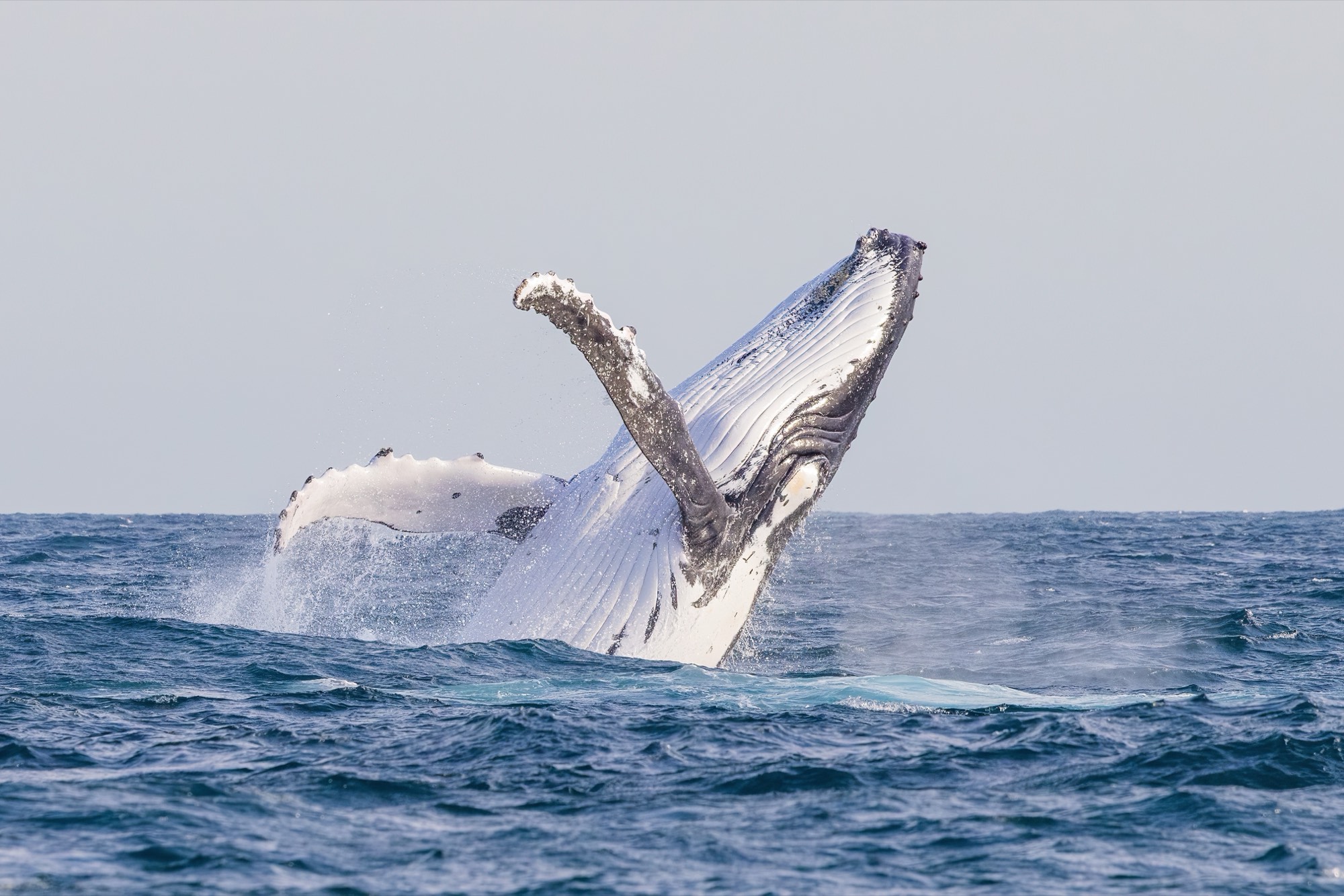
Humpback whales regularly breach their 30-ton bodies out of the water in spectacular aerial displays. Nobody yet knows exactly why they do it.
Recording: NOAA. NOAA Fisheries, NEFSC, Passive Acoustics Branch. 2023. Humpback Whale. NOAA Sounds of the Ocean
Life of a humpback whale
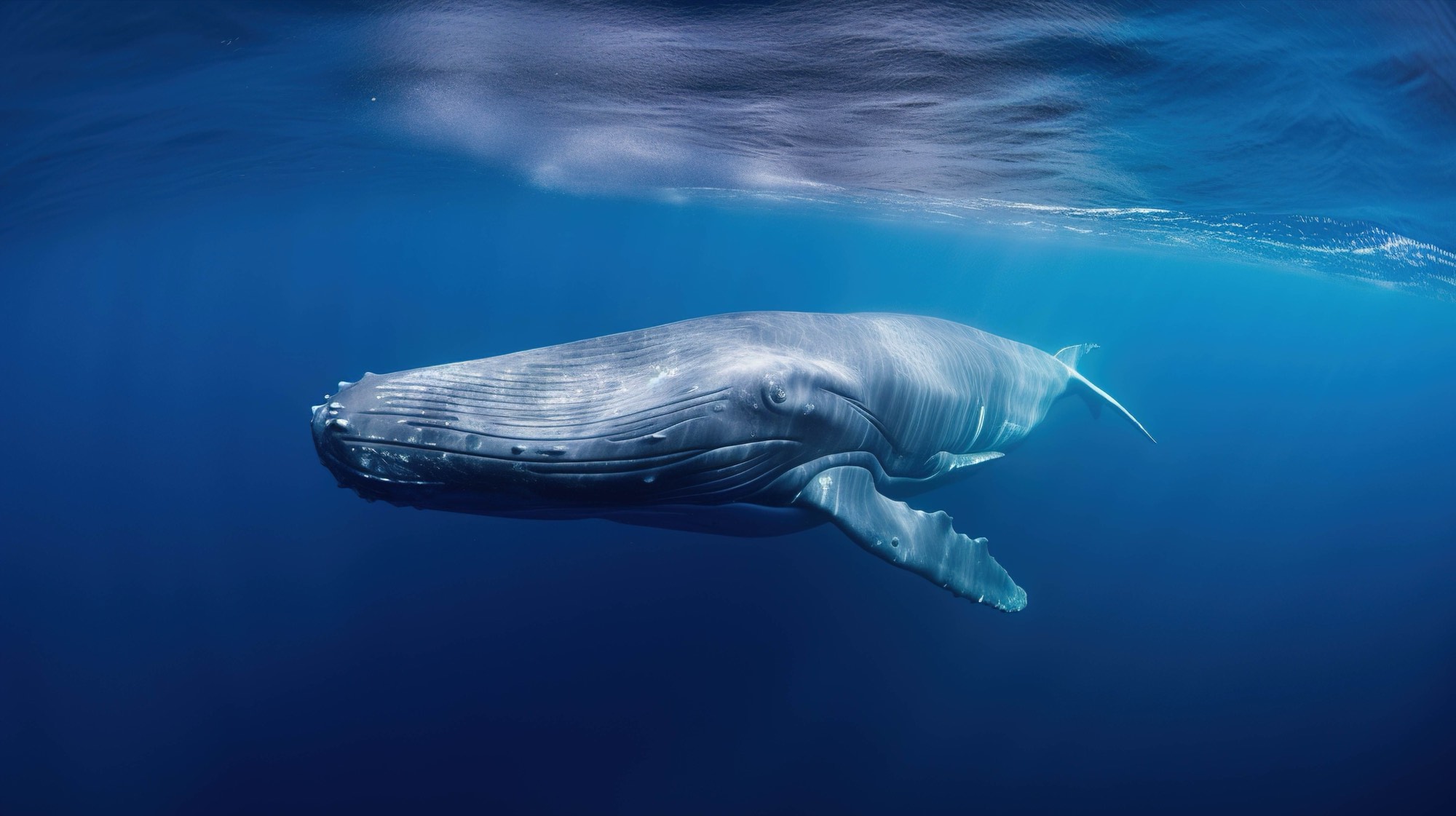
The humpback whale (Megaptera novaeangliae) is one of the best known Mysticeti whales. Features such as its use of traditional breeding grounds and preference for nearshore habitats are welcomed among scientists. It is also relatively easy to identify individuals because the underside of its tail fluke is uniquely patterned.
Life starts with a gestation period of 11-12 months culminating in birth in warm tropical waters during winter. You are born around 4-4,6 m long and are strong enough to begin migration to feeding grounds after only a couple of weeks. The first 6 months you nurse exclusively, but after this you start feeding for yourself, and when you are about 11 months you are self-sustaining and weaned. You stay with your mother until your second winter in the breeding grounds. Now you are on your own, and you begin the journey toward reaching sexual, social and physical maturity. You will associate in small unstable groups and be especially social on the feeding and breeding grounds. You might form a long-term relationship, but it is rare.
You follow your mother’s pattern of migrating between breeding and feeding grounds, and after five years you are sexually mature. Physical maturity happens between 8-12 years of age. Mating success comes down to whether you are male or female. Young males are mostly outcompeted by older males in polygamous mating systems like that of the humpback’s. If you survive the first years, you are likely to live 50 years or more.
Incredible talent for singing
The song of humpback whales was first recorded in the 1950s by the US Navy. These recordings reached Roger Payne, who quickly made his own recordings in the 1960s. In 1970, he released “Songs of the Humpback Whale,” which was an instant public hit. It ended up playing a major role in the shift in attitude towards whales. And ultimately the protection of them. The songs have even made it aboard the Voyager spacecraft as a way to communicate with alien species.
As described by Payne and McVay in 1971, humpback songs consist of single units of sound that make a phrase, the repetition of these phrases is called themes, and a song consists of several themes sung in a particular order. These songs are loud (can be heard at least 15 km away) and vary in length from a couple of minutes to 30 minutes. Singing may be done for hours. The frequencies go from 30-4000 Hz. The sounds can be whistles, moans, grunts and rattles. The units of the song can be arranged in many ways, and the structure determines the song. Research has even found that the songs include rhymes. Only male humpback whales sing.
The structure of the songs changes over time and all singing males within a population keep up with these changes. Humpbacks from different ocean basins sing different songs.
The structuring and constant updating of the songs might make you think of culture. How can these large numbers of whales keep up with the changing of songs and all sing the same song? The evolutions in the songs all happen on time scales much shorter than the lives of the whales and therefore should not be genetic. The songs can also change radically over as short a period as two years. The song of humpback whales off the Australian east coast was completely changed over a couple of seasons. It was seemingly because of a few visitors from another area. This visit introduced a new song, and suddenly everyone wanted to sing only this song. This kind of rapid change is very rare in animal vocal tradition.
Migration
Humpback whales are highly migratory, traveling as far as 8000km one way. They migrate in order to spend spring, summer and fall on feeding grounds in the high latitudes and breed in tropical waters during winter. Many keep going back to the same breeding and feeding grounds shown to them by their mothers. As the exception, the population living in the Arabian Sea does not migrate.
We don’t know much about how they navigate on their long migrations, but through satellite tagging it is clear that they follow straight tracks, so they must know where they are going.
But why spend all this energy on migrating? The function of the migrations is as of yet unknown, but several educated guesses have been made. The most popular belief is that migrating to tropical breeding grounds provides an advantage to calves. Both due to the warmer climate and facing less risk of predators. The problem with this theory is that it does not explain why non-pregnant females and males undergo the journey. Another popular guess is that it is simply most energy efficient. Taking advantage of the high abundance of food during summer and then moving to warmer waters to save energy for fasting during winter. The warm waters convey a significant thermodynamic advantage, so it might be worth it.
Feeding
The humpback whale is considered to have a generalist diet including capelin, herring, mackerel and krill. The commonality is the schooling or patching of the prey. The prey needs to be aggregated to allow for effective lunge feeding. As with other balaenopterids (blue whale, fin whale) the ventral pleats (the folds that go from the tip of the lower jaw to its umbilicus) are capable of extreme expansion, which makes the engulfing of huge amounts of water and prey possible. The ventral pouch can expand by as much as 162% in girth! The baleen then traps the prey when the water is being expelled by the belly and tongue.
The humpback whale is a lunge feeder, meaning that it ambushes its prey by quickly accelerating up to speeds of 5m/s.
The unique part of humpback whale feeding is the use of bubble feeding. They produce these complex bubble-nets by exhaling air from the blowhole while swimming in a circular pattern underneath the school. The bubbles then rise and form curtains. The whales show great control in these nets, varying size, shape and spacing between bubbles. This type of feeding among baleen whales is likely restricted to humpback whales. Because of their long flippers (1/3 of body length) they are very maneuverable, which makes it possible. The technique is performed both alone and cooperatively.
When performed alone, the nets were always produced in a clockwise direction, and each successive ring was smaller than the one before. The bubble curtains act as a barrier to krill and schooling fish. This in effect concentrates the prey and should lead to greater foraging efficiency. One study even found that the prey intake was, on average, seven times greater than for regular lunge feeding.
Depending on your definition, this can be termed tool use. General criteria of tool use are fulfilled. Bubble-nets are unattached and employed externally.
Humpback whales are known to come to the rescue of other marine mammals. This includes the situations previously described of saving seals and other humpbacks. Robert L.Pitman and his team reviewed 115 interactions between humpbacks and killer whales. Surprisingly, 57% of the time it was the humpbacks initiating contact. In the cases where the killer whales were hunting when confronted by humpbacks, only 11% of the time was it a humpback that was aided. 89% was of 10 other species. The humpbacks traveled up to 2 km to provide help and defended for up to almost 7 hours. Whether approached by the killer whales or approaching themselves, the responses were the same. The behaviors included: slapping flukes at the surface, slashing flukes from side to side, bellowing, flipper slapping and pursuing. Observers reported the humpbacks facilitating the escape of several animals ranging from other humpbacks to sea lions.
A quote from the article describes an interaction: “After being attacked by a group of approximately 15 killer whales, a humpback cow/calf pair joined a trio of humpbacks, and for the next few minutes we could see what clearly looked like the three Humpback whales chasing off the Orcas! The Orcas left the scene completely, all the time with the three Humpbacks behind them”.
Whether this is seen as altruism is up for debate, but it is possible.