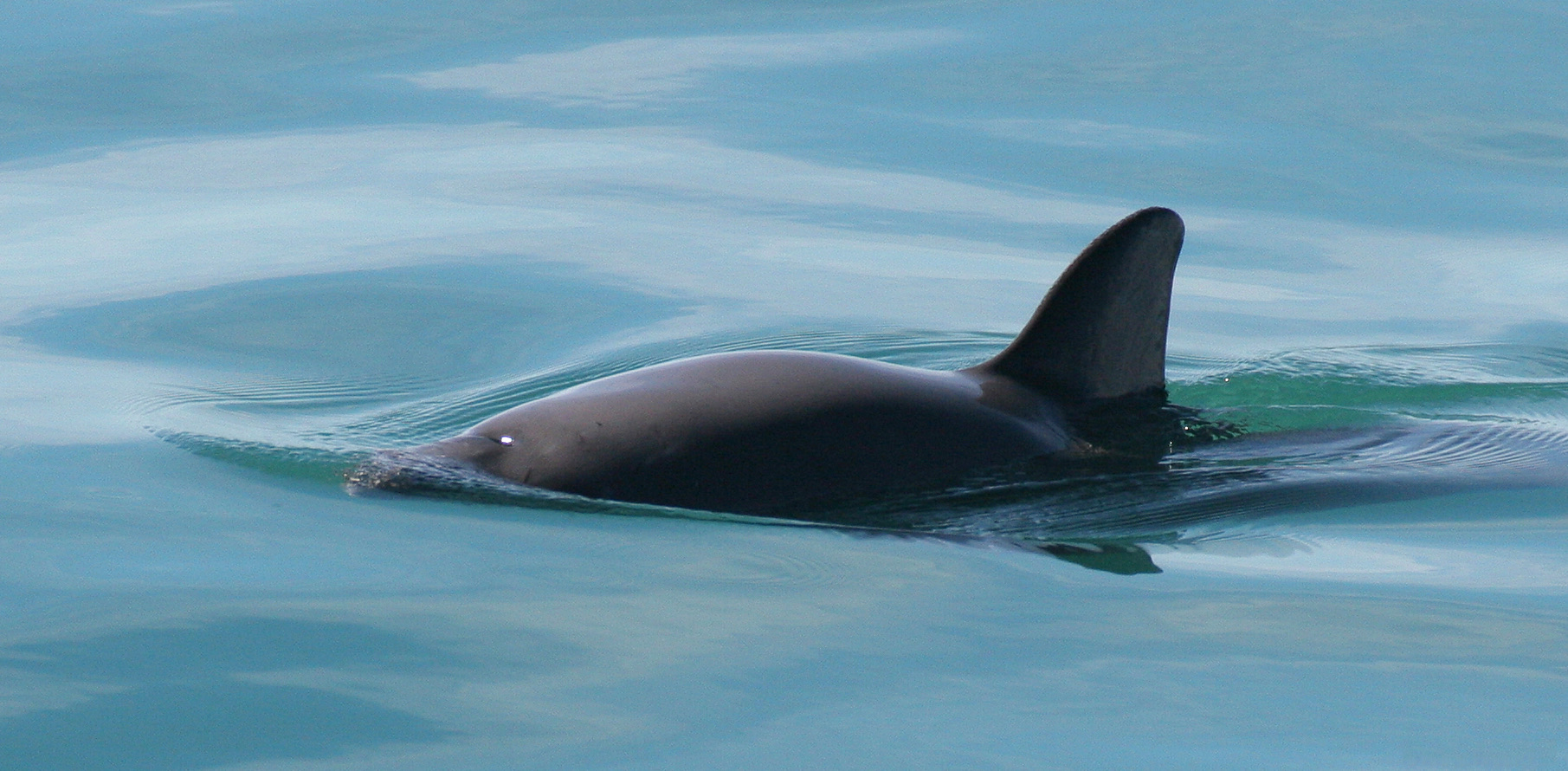
There are fewer vaquitas left on Earth than there are players on a football team. They are the smallest porpoise in the world, they live in one small corner of one sea, and they are drowning in nets set for a fish they have nothing to do with.
Vaquita
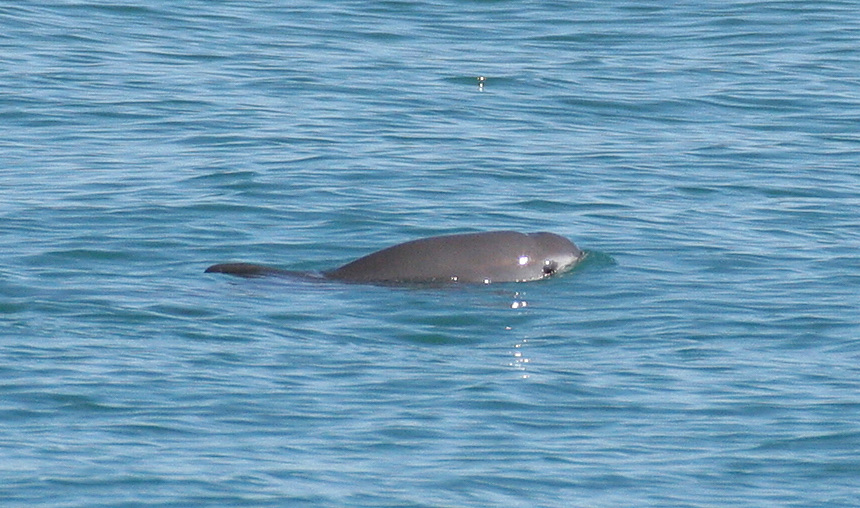
The vaquita is a porpoise and is the smallest cetacean. You can recognize them by their black eye rings and lip patches. They also have relatively large dorsal fins, flippers and flukes. It is suggested that this is to reduce body temperature in the warm waters they call home.
They only live in the Upper Gulf of California in an area of about 4000 square km, which is the smallest area of any cetacean.
They prefer areas that are 20-40 meters deep and cloudy. The seeking of turbid waters is likely to avoid predators and because of high prey densities. Vaquitas are not picky eaters - they eat a wide variety of bottom-dwelling fish, squid and crustaceans.
Vaquitas are elusive and have been hard to study due to their avoidance of boats. They don’t perform out-of-water acrobatics like dolphins, so you only see them when they come up for air. They're usually seen in pairs, but groups of up to 8-10 have been spotted in the past.
Only about 7-10 vaquitas remain as of the 2025 survey. It is the world’s most endangered mammal, largely because of humans and the exploitation of their habitat.
Threats
Vaquitas only live in one place, have likely had low population sizes throughout the last many thousands of years, show almost no variation in their mitochondrial DNA, and share habitat with the totoaba. All these characteristics make them very vulnerable to extinction, and if something radical is not done soon, they will likely face extinction.
The biggest and most dangerous threat they face is entanglement in fishing nets. The Gulf of California is heavily fished for many fish- and shrimp species. The nets used are very dangerous to vaquitas. Especially the gillnet catches them. Gillnets are made to catch fish by their gills, but the nets can’t discriminate between fish and vaquitas, so all get caught. Many actions have been taken to safeguard the vaquita, like phasing out the use of gillnets, but the remaining illegal gillnets used for the totoaba (its swim bladder is very popular in Hong Kong and China) still catch vaquita. The mesh size of these nets is about the same as the girth of a vaquita head, making them especially dangerous. Fishers may receive as much as 8500 dollars for a kilogram of totoaba swim bladder. It is therefore very hard to prevent this fishing and the swim bladders from entering the black market. The illegal fishing for totoaba is the greatest threat to the vaquita.
Crime
The Gulf of California is a very productive marine region providing a home to many species. It is, for the same reason, very attractive to everything from small-scale fisheries to commercial ones. Significant efforts from both the Mexican government and international communities have sought to protect the local wildlife, like the vaquita. The high demand for totoaba swim bladders has, however, rendered many of these efforts insufficient. The totoaba is protected under Mexican law, and international trade is banned under CITES Appendix I. Despite this, the illegal fishing of this species continues, with the side effect of killing the vaquita too.
Organized crime groups play a large role in the continued trafficking of these swim bladders.
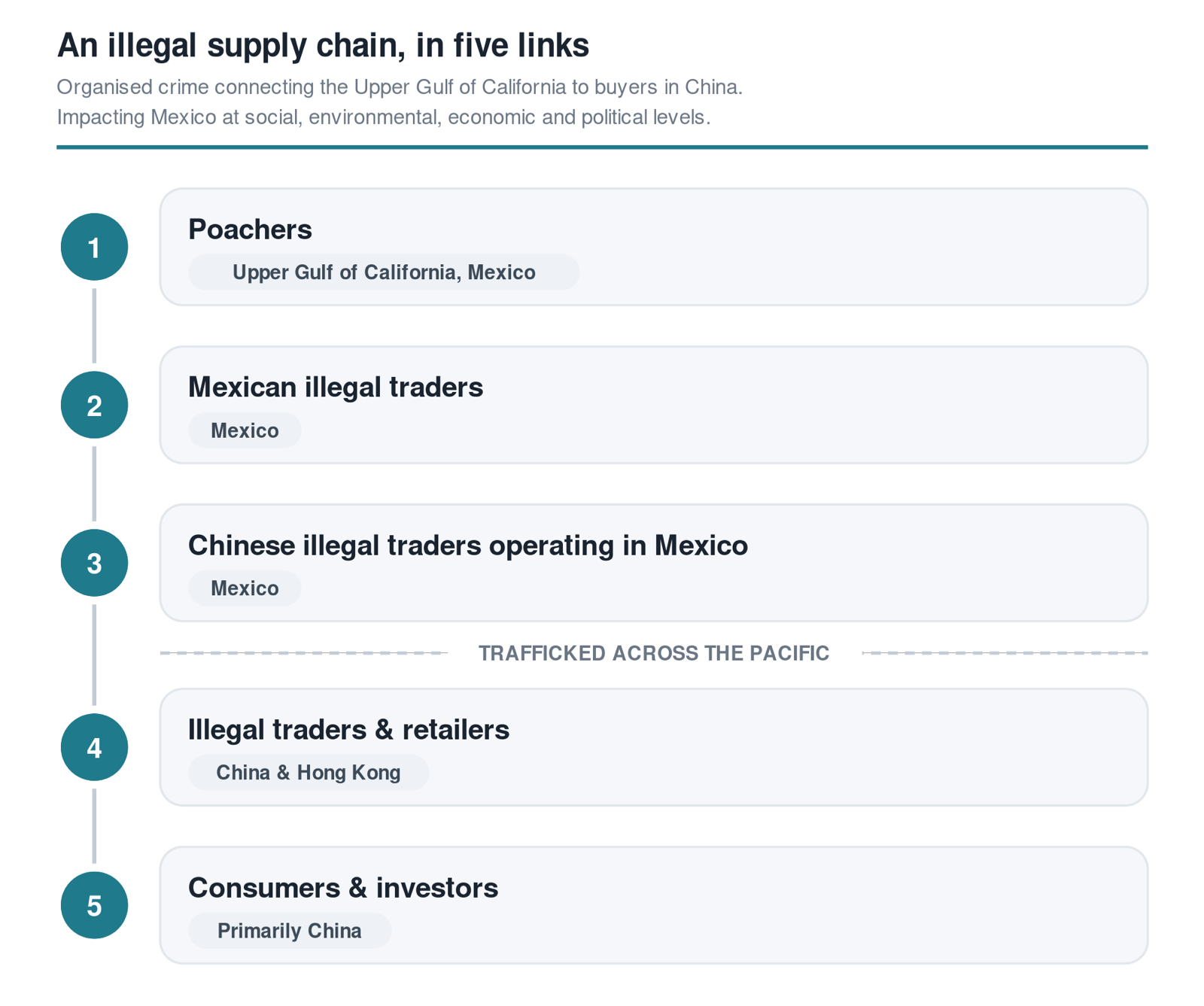
The supply chain consists of five main points: 1) the poachers in the Upper Gulf of California, 2) the illegal traders from Mexico, 3) illegal traders in Mexico from China, 4) illegal traders and retailers in China and Hong Kong, 5) consumers mostly from China.
In broad terms, it works like this: illegal fishers catch totoaba for “totoaba cartels”, which are Mexican criminals and Chinese traffickers based in Mexico. The swim bladders then get smuggled through transit countries to consumer destinations primarily in China, but also in the USA and Hong Kong.
This challenge is more than a conservation issue. It must also be treated as a criminal endeavor, and the focus likely needs to be higher up the supply chain as well as on the fishers. Saving the vaquita probably means strong cooperation between Mexico, the USA, China and transit countries, so that all levels of the supply chain can be targeted.
Conservation of the vaquita
Efforts to save the vaquita have been extensive and mostly target the bycatch threat. These efforts include: bans on gillnet fishing, promoting alternative fishing gear that is less dangerous to vaquitas, and helping fishing communities build livelihoods not dependent on destructive fishing methods. The efforts are made by both national and international organizations. The Mexican government has spent 113 million dollars on different conservation plans, including compensation programs, military operations and research.
Back in 2017, another attempt to save the vaquita was undertaken. The effort had 90 experts from 9 countries and cost 5 million US dollars. The plan was to capture a few of the wild vaquitas for temporary protection until their habitat was safe again. Two vaquitas were targeted - a juvenile and an adult female. The juvenile was released again after 4 hours because of stress, and the adult female died of capture myopathy (an exertion- or stress-induced muscle degenerative condition). The program was stopped after this, and due to the heavy stress vaquitas experience when captured, the only possible way to save the vaquita is in the wild.
A study by Lorenzo Rojas-Bracho states that science is no longer the determining factor in the survival of the vaquita. It now depends on political will, conservation strategy and public pressure. Especially the socio-economic challenges must be addressed. The conservation strategies benefiting the vaquita come at a cost to the local communities. The communities in this area are tied to fishing, and not many alternatives currently exist. It is therefore very important to create attractive alternatives for these fishers, likely needing subsidies at first. New jobs and training for those jobs are necessary if the fishing is to decline.
The good news is that the remaining vaquitas are healthy and reproducing, with calves being spotted in recent years. The challenges they face are significant, but with the right actions from especially Mexico, the USA and China, they can still be saved.
One possible concern in the recovery of the vaquita would be the very small population potentially creating genetic problems connected with inbreeding. This does not seem to be a problem with the vaquita, however. Genetically, vaquitas are very much alike, which signals that they have had very low population sizes for likely tens of thousands of years. They all have the same mitochondrial lineage, and since mitochondrial DNA only comes from the mother, this means that all living vaquitas stem from the same maternal line.
Most species carry hidden dangerous mutations, which do not matter so long as they only have one copy of the harmful allele. It only becomes a problem when relatives mate, and the offspring receive two copies. That is called inbreeding depression. The small population of vaquitas has a low burden of dangerous mutations because of natural selection pressure. In a small and related population, the mutations surface due to frequent mating between relatives. The offspring with the dangerous mutations don’t survive, so the mutations die off. In a large population, many individuals will possess one copy of the mutation (since they are harmless alone, they are not removed), which becomes dangerous if a sudden drop in population numbers occurs. This will lead to inbreeding and thus a high number of dangerous mutations, which threatens the survival of the population.
So because the vaquita has had so many years of low genetic diversity, they are positioned quite well to repopulate this very small population, not because diversity is low, but because thousands of years of small population size have already purged most of the harmful recessive variants. This leaves hope that they can rebound and once again thrive if we manage to protect them.