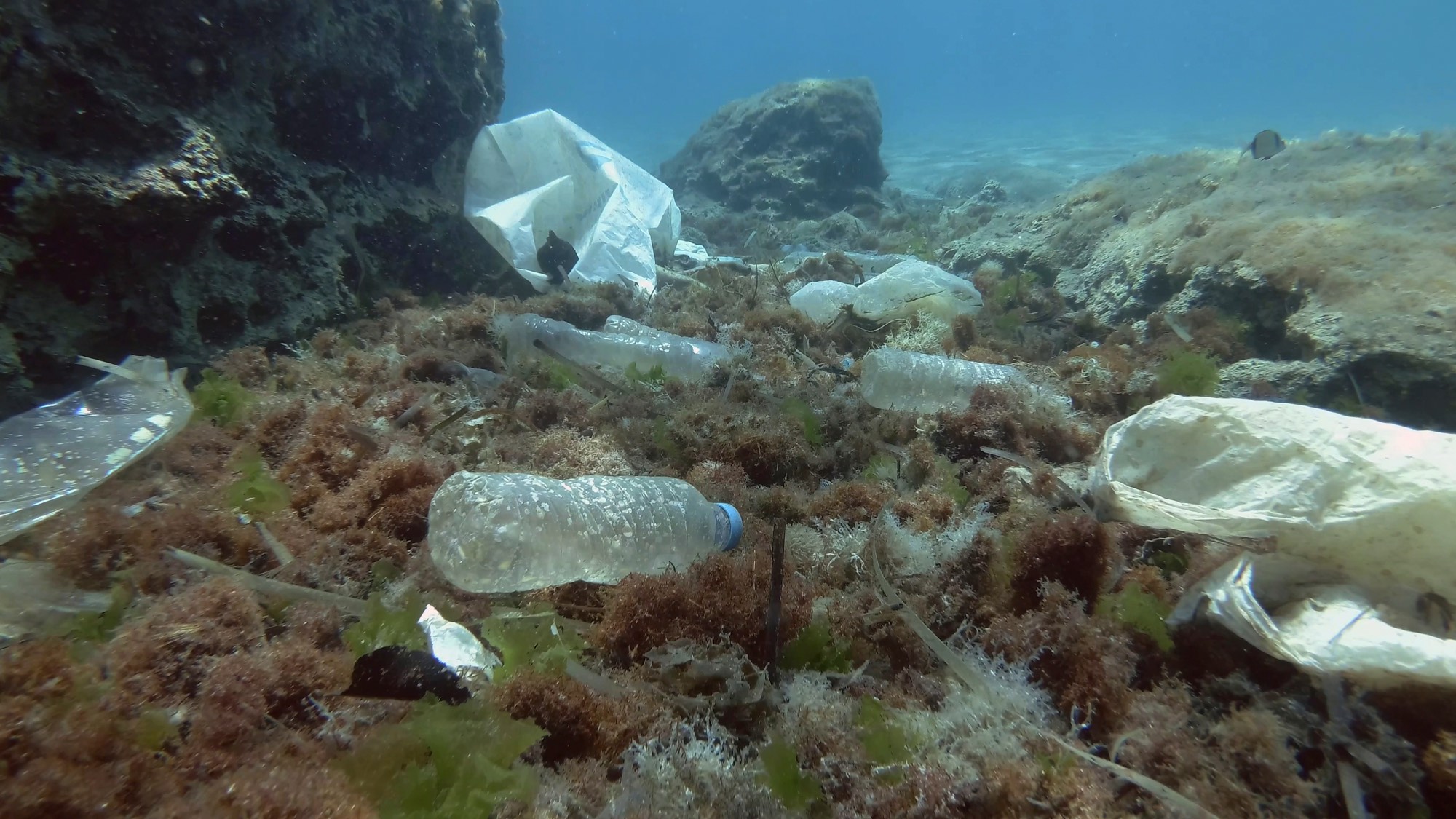
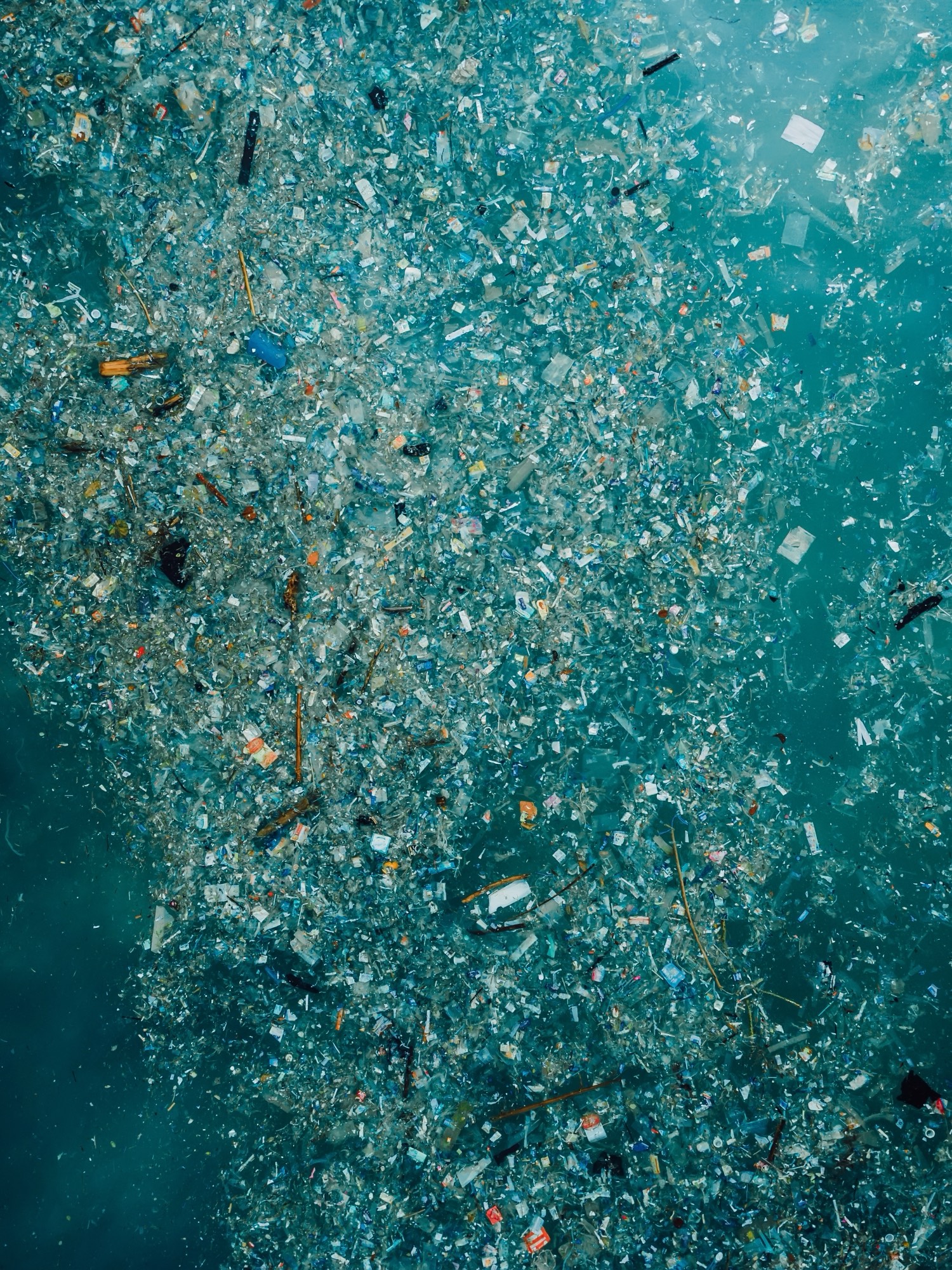
Some of the ocean's pollution you can see — a swirl of plastic debris spread over an area three times the size of France. Some of it you cannot: chemicals banned decades ago, still hiding in the blubber of whales. Both are now among the greatest threats cetaceans face.
Plastic pollution
Plastics have become a big part of our lives. Due to plastics being inexpensive, lightweight and durable, they have changed our lives for the better. It has made electrical goods much more common and allows a clean means of water distribution, just to name a very few functions. With a growing population and continued need for plastics, the production of plastic has risen from about 2 million tons a year to over 400 million tons per year since 1950. One of the issues with plastic is that much of it is used as disposable packaging articles. More than a billion single-use plastic bags are given away for free daily. Up to 2% of plastics produced end up in the ocean. Every minute, the equivalent of a full garbage truck’s worth of plastic is thrown into the sea. Over 150 million tons of plastic are already found in the sea.
The positive properties of plastic, like the aforementioned lightweight and durability, become a problem in the ocean. Plastics don’t biodegrade; they only break into smaller and smaller pieces, eventually being consumed by some of the smallest marine life species. The smallest of these pieces are called microplastics, and they outnumber the stars in the Milky Way by 500 times.
Almost half of plastics are buoyant and can therefore travel long distances through currents. The contamination reaches across oceans and even to the most remote islands. Between California and Hawaii, one finds a plastic accumulation zone called the Great Pacific Garbage Patch. Estimates point to at least 79 thousand tonnes of ocean plastic found in this 1.6 million sq km area. At least 46% of this plastic is old and discarded fishing nets.
Almost all marine species are affected by this pollution, even those that live nowhere near humans. At least 900 marine species have been reported to either ingest or get entangled in plastic debris. The results include impaired movement and feeding, reduced reproduction, lacerations, ulcers and death.
Plastic debris
It was not until the late 1970s that the dumping of plastics in the ocean got any attention. Today it is recognized as one of the major challenges facing the marine environment. Ingestion and entanglement are two consequences of the high levels of plastic in the ocean. The ingestion of plastic debris has been extensively reported in sea birds and sea turtles. It is rarer for cetaceans, but several cases have been recorded. 48 species of cetaceans have so far been reported to have ingested debris. And it does not take much debris to be hazardous for cetaceans. Small quantities can, for example, occlude the intestinal tract.
In one unhappy case, two sperm whales stranded in California. Their necropsies determined that they had 24.2 kg and 73.63 kg of debris in their stomachs. The debris included ropes, plastics and nets. 134 types of nets were found in these two whales, ranging in size from 10 sq cm to 16 sq meters. For the first whale, the cause of death was thought to be gastric rupture as a result of impaction with debris. The second whale was thought to have starved to death due to gastric blockage based on the emaciated state the whale was found in.
There are several more cases of ingested debris causing serious ailments to cetaceans. It is an increasing problem and seemingly especially so for deep-ocean suction feeders (sperm whales) and ram feeders (right whales).
Chemical pollution
Human-produced organic and inorganic chemicals constantly end up in our oceans. Many of these can be dangerous and complicating factors for cetaceans. Persistent organic pollutants (POPs) and trace elements have increased in nature due to human activities. POPs have been used as pesticides, industrial chemicals, solvents and pharmaceuticals. POPs are stable and do not degrade easily. POPs are relatively easily accumulated in whales due to several reasons: 1) they are soluble in fatty tissues, 2) they are poorly metabolized, 3) they bind easily to the surfaces of solid particles. These three mechanisms mean that POPs are readily accumulated in fatty tissue through ingestion of prey that ingested the POPs. Being at the top of the food chain means that cetaceans accumulate some of the highest levels of chemical pollutants seen in wildlife. A further complicating matter is the fact that at higher temperatures, POPs evaporate and thereby reach the atmosphere, which means they can travel far and accumulate even in remote areas like Antarctica.
Pollutants such as DDT, PCB, and TBT are endocrine disrupting chemicals (EDCs). This means that they affect the hormonal system, which can affect reproduction by causing birth defects and developmental disorders, immune cell generation, and can even cause tumors. Particularly, embryos, fetuses and newborns are susceptible to EDCs.
To add to this already complicated picture, the chemical pollutants can also have synergistic effects. Meaning that effects between different pollutants can amplify the toxicity of some of the chemicals. Environmental factors also matter. For example, starvation, pathogens and changes in water temperature can all amplify the dangers of the chemicals. It is hard to connect specific ailments to specific chemicals, because EDCs are persistent and cause long-term complications. It seems, however, that highly contaminated animals are in greater danger of catching diseases.
Southern resident killer whales
The population of southern resident killer whales is one of the best-known killer whale populations in the world. Their summer locations in the waters off of British Columbia and Washington State afford plenty of opportunities to study and watch them. They are also listed as endangered in both Canada and the USA and are in a uniquely poor position in terms of chemical pollutants. They are long-lived (which means plenty of time to accumulate chemicals), top of the food chain predators and live close to humans and pollution. The prey they highly prefer, Chinook salmon, are close to industrial discharge, urban drainage and agricultural run-off areas. All with high concentrations of POPs. The southern residents are, for that reason, much more contaminated than other fish-eating killer whale populations. Especially the POPs PCB, PBDE and DDT are found in these whales. These particular POPs can cause endocrine disruption, reproductive disruption or outright failure, immunotoxicity, neurotoxicity, neurobehavioral problems and cancer.
Taken together with the reduced populations of their prey, the Chinook salmon, these pollutants can become particularly dangerous. The reduced prey availability means that the killer whales must use their stores of blubber for energy. This can cause the POPs, which were bound in the blubber, to enter the circulation, where they can cause a toxic response. The nutritional stress therefore has a synergistic effect with the POPs.
The southern resident population, as of July 2026, numbers 76 whales, and they are struggling, showing little sign of recovery. The population growth is low due to low offspring production for the reproductive females. Chemical pollution, lack of prey and vessel disturbance are the likely factors constraining the whales.
Until their ban in the USA in the late 1970s, polychlorinated biphenyls (PCBs) were widely used. Globally, they are no longer produced, but they remain in the environment, and still more are added through leaks from old equipment, sediments and buildings. PCBs magnify in the food chain, so apex predators are more susceptible to them. Killer whales are some of the most PCB contaminated mammals in the world. A study by Jean-Pierre Desforges used an individual-based model framework to ascertain the risk faced by killer whale populations around the world from PCBs. They found that more than half of the world’s killer whale populations were severely threatened by the effects of PCBs. Effects from PCBs over the coming 100 years were predicted to cause a high risk of population collapse for killer whales living near industrialized areas and the populations feeding at the very top of the food chain, no matter the location.
Despite the ban on PCBs being many years ago, it continues to threaten and affect the environment with potentially catastrophic consequences.