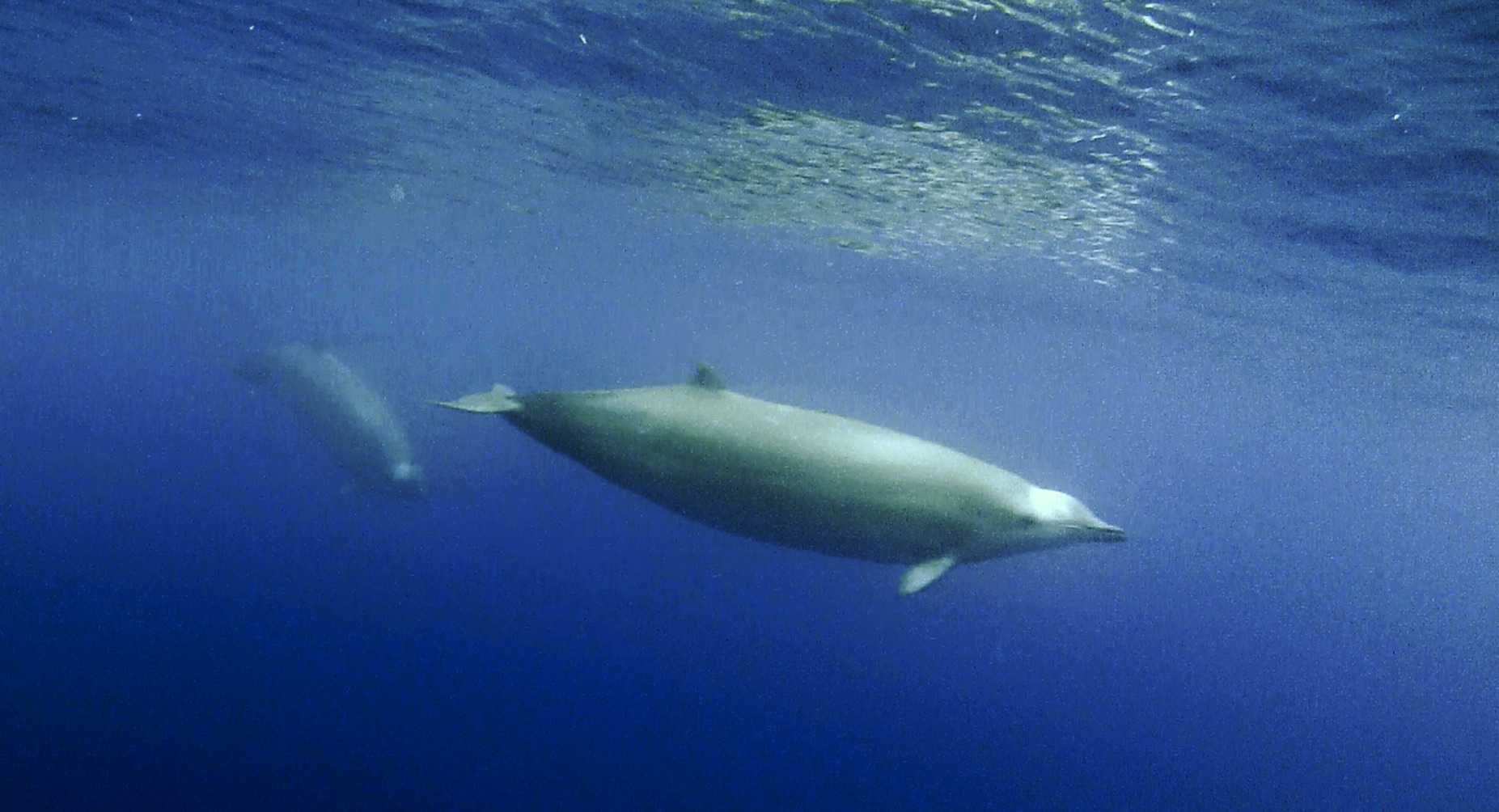
Beaked whales are the most mysterious of all cetaceans. Most of what we know comes from tags and strandings. What takes place in those deep, dark waters?
Recording: NOAA. NOAA Fisheries, NEFSC, Passive Acoustics Branch. 2023. Cuvier’s Beaked Whale. NOAA Sounds of the Ocean
Overview
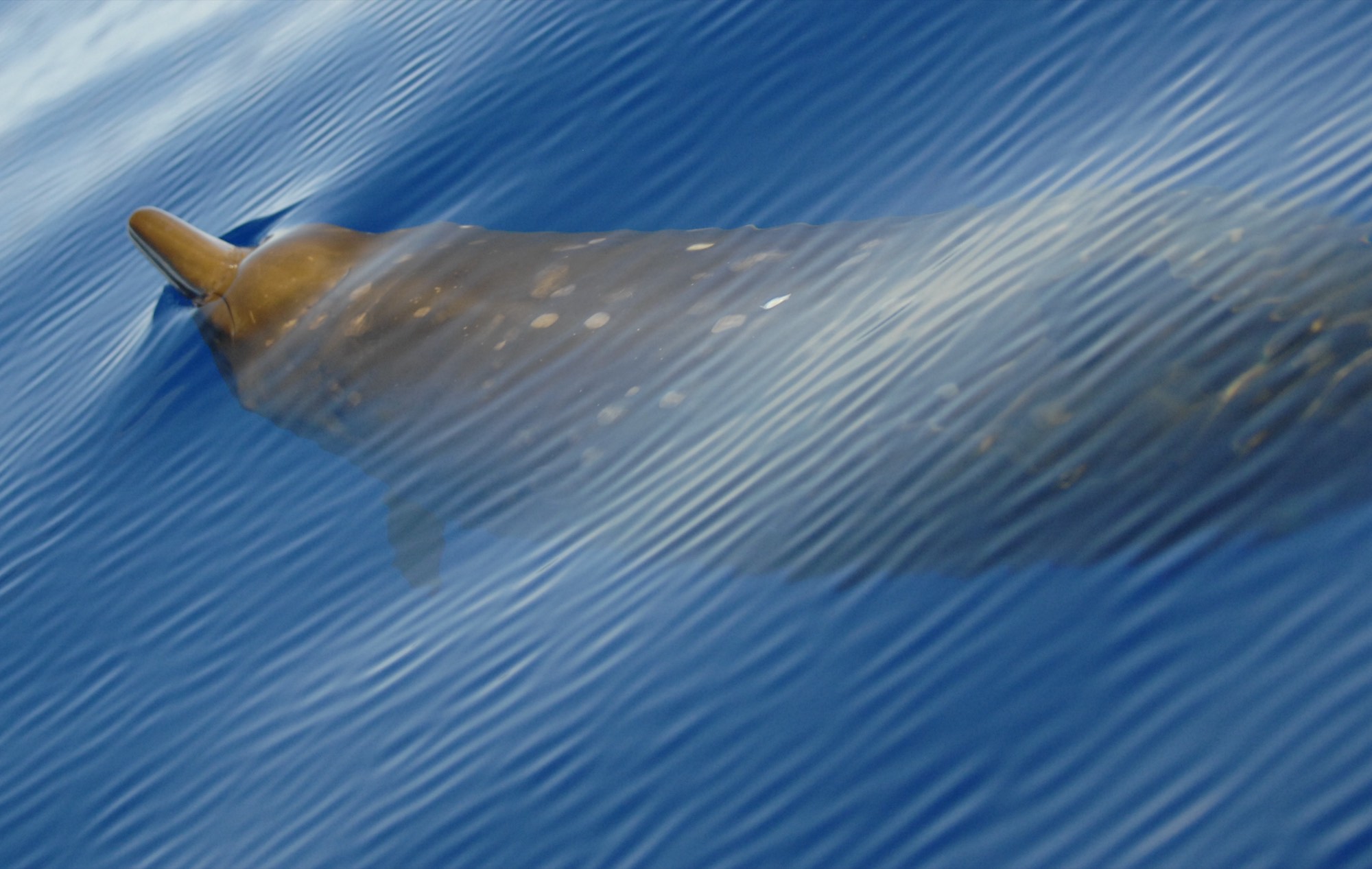
The beaked whales belong to the family Ziphiidae, with about 24 species. Beaked whales are between 4m and 13m, and in most species only males have teeth - for example, a pair of tusks that are used in combat. Beaked whales mostly don’t need teeth because they suck their prey into their mouths. The common characteristic of beaked whales is their impressive diving abilities. They forage at great depths and therefore live only in waters at least 200m deep (although typically deeper than 1km), which makes them mostly oceanic. Given their preferred habitat, not much is known about the social lives of beaked whales. It does seem to vary between species. Baird’s beaked whales seem to live in fission-fusion societies like the bottlenose dolphins we have previously encountered. This means that they have loose structures and move quite a bit between groups. Cuvier’s and Blainville’s beaked whales are more solitary and are typically found in small groups of 2-7 whales. It is suggested in a study by Ana Bádenas that Blainville’s beaked whale females stay in one area for long periods and control this area, while remaining together. The males then lead these groups for hours to months, defending them from other males. Thus keeping the “resource,” in this case, the females to themselves. In Longman’s beaked whale, groups of 5-20 are the norm, and groups of even 100 are observed. The social lives of beaked whales are quite diverse and still not very well known. They do, however, display a mix of some of the characteristics of other Odontoceti, like strong female associations and fission-fusion societies.
Diving
Beaked whales mostly eat deep-water squid, however, some beaked whales prefer deep-water fish. The commonality is that they must dive to great depths to catch them. They are perhaps the most impressive mammal-diver with routine dives of more than 1500m and breath-holds of more than an hour. The record is held by the Cuvier’s beaked whale with a dive of 2992 m deep! Another Cuvier’s beaked whale was able to hold its breath for 222 minutes, which is also a record. These were most likely extreme dives, with most dives being shallower and shorter. Diving this deep and for this long presents a multitude of challenges.
Mammals need oxygen for their aerobic metabolism, however, when lacking in oxygen, anaerobic metabolism becomes necessary. Anaerobic metabolism is less efficient and builds lactic acid. The ability to hold great oxygen stores and decrease metabolism is, therefore, a major benefit of deep-diving animals. Deeper and longer dives likely require some amount of anaerobic metabolism, which makes longer breaks between dives necessary. The longer dives must therefore come with a benefit worth decreasing foraging time over. The intervals between deep dives were 63 minutes and 92 minutes for two species of beaked whale. This interval was likely due to needing recovery from running low on oxygen.
Mostly, however, it is more efficient to do easier dives. A study of Cuvier’s beaked whale found that their rhythm consisted of two types of dives: deep dives (more than 800m) and shallow dives (50- 800 m). The deep dives lasted for a median duration of 58.9 minutes, and the shallow ones lasted 18.7 minutes. Time at the surface between dives was mostly just a few minutes, but with longer intervals interspersed. The regular diving pattern is thus likely a mix of depth and length, which allows for recovery between dives.
Hiding in the deep
Diving animals are generally expected to maximize the time spent foraging when underwater. This can mean ascending and descending rapidly, like the sperm whale, or almost continuously echolocating. Cuvier’s and Blainville’s beaked whales seemingly don’t do either. They only echolocate during the deepest part of the dive, and they ascend at a low angle. This has led Natacha Aguilar de Soto and her team to suggest that it is a response to predation. Beaked whales are vulnerable to large sharks and killer whales. One issue with echolocation is the possible eavesdropping of other echolocating species, like the killer whale. The echolocation used to detect prey can then become a broadcast of your exact position to predators. Given that beaked whales are neither very large nor commonly live in large groups, they must find protection in other ways. The seeming solution is hiding. Killer whales spend most of their time in relatively shallow water and have limited diving duration capabilities. The deep waters, therefore, protect the beaked whales. Beaked whales also coordinate their deep dives, so they all dive together, despite foraging alone. This limits the time the killer whales can eavesdrop to less than 25% of the time.
The breathing intervals are the dangerous part for beaked whales. They mitigate this risk by covering an average of 1 km horizontally on ascent in complete silence. This means that killer whales can’t simply wait at the spot where they last heard the beaked whales. The surfacing is far from where the last sound was produced.
This strategy comes at a price, though. The long, silent ascents reduce foraging time by an estimated 35%, and the group diving means that the bigger and more capable diving individuals must limit themselves to fit the group. The increased survival must outweigh these costs, since these impressive skills have evolved.
Mass strandings
Increasing noise pollution in the world’s oceans is a growing reason for concern. It is hard to quantify the exact level of effect it has on cetaceans, but it is a serious threat. It can affect hearing, stress levels, and foraging and lead to strandings, to name a few concerns. Especially beaked whales have been sensitive to man-made ocean noise. The use of military sonar seems to be the reason for fatal mass strandings of at least 8 species of beaked whale. In an experiment conducted by Peter L. Tyack, it was shown that beaked whales react by going silent at sonar signals of 138 dB. Responses to such noise are to swim up to tens of kilometers away from the sonar. This reaction can be dangerous if it leads to shallow waters, which can lead to strandings. The stranded animals that have been examined showed signs of decompression sickness, such as gas bubble lesions and fat emboli. This was likely due to alterations in behavior, like ascending faster or more slowly, as a response to sonar. Deep divers, like beaked whales, are likely susceptible to dangers if they have to change their dive profile in any way. This can be prolonging the dive or remaining at the surface for a longer time. These could lead to high levels of nitrogen in tissues, which creates gas bubbles, like in decompression sickness in human divers. The exact mechanism behind the strandings is still speculated upon, however. A less likely theory is that the sound itself may damage the whales. Sound waves can potentially make gas bubbles grow through a process known as rectified diffusion. This would increase the risk of gas emboli, which carry a lot of risks, like obstruction of blood flow.
Even if not lethal, these effects are very disturbing to the whales, with changes to their diving, disrupted foraging, and the evacuation of areas with sonar. This has high energetic costs. More research on this topic is important and might lead to more sonar moratoriums, like the one in the Canary Islands.
Before the 1960’s, mass strandings of beaked whales were very rare, but along with the navy’s new use of frequencies in the range of 4.5-5.5 kHz, beaked whale mass strandings skyrocketed. Between 1960 and 2004, 121 beaked whale mass strandings were reported. At least 37 of these were linked to naval activities. The Spanish Canary Islands were a hotspot for beaked whale mass strandings. Back in 2002, there was a large stranding of 14 beaked whales during a naval exercise, which used the dangerous mid-frequency sonar. Necropsies of the whales showed symptoms of decompression sickness. In 2004, another four beaked whales lost their lives after a naval exercise. That same year The European Parliament called on its members to implement a moratorium on the use of “high-intensity active naval sonars”. Only Spain followed the advice and imposed a moratorium around the Canary Islands. This moratorium has proved a great success story with zero mass strandings since. It perfectly illustrates that we are capable of protecting these whales by safeguarding areas of particular importance.