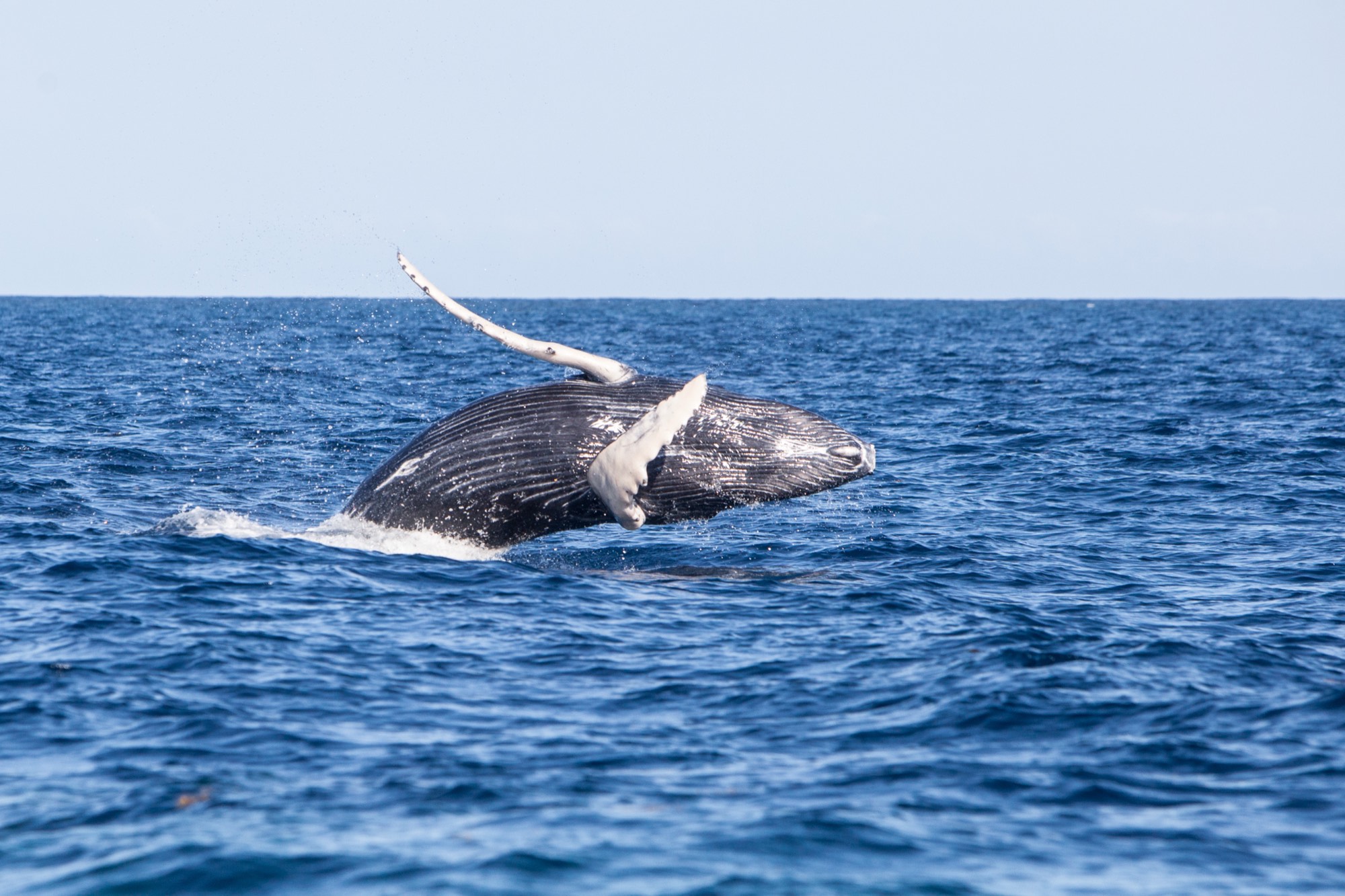
Baleen arrived about 30 million years ago and has proven to be one of the most remarkable adaptations in mammals. It has created the largest animals to ever live on Earth.
Overview
The need for food is universal among mammals in order to grow, reproduce, and sustain themselves. This need is likely what led the ancestors of modern whales to return to the water. The coastal waters were highly productive and relatively unexplored about 50 million years ago. Since returning to the water, whales have accumulated a remarkable set of helpful adaptations to life in the oceans. These adaptations have allowed whales to play a significant ecological role in the transfer of energy through food webs. When exploring this role, it is important to look at the feeding mechanisms. Filter feeding is one of nature’s great inventions. Filter feeding has evolved in multiple lineages of both vertebrate and invertebrate species. For example, leopard seals and crabeater seals have evolved filter feeding (not baleen, though). The focus of this lesson, however, is the baleen whales. The biggest and most impressive of the filter feeders. Filter feeding has created the largest animals the world has ever seen by facilitating the consumption of many abundant organisms in one go. Filter feeding exploits the patchiness of the ocean’s primary producers, which tend to be aggregated in productive waters. The large concentrations of primary producers attract zooplankton and small fish (prey of baleen whales). This means that baleen whales often migrate to find these dense patches of prey. The large body sizes of baleen whales also allow them to live off their summer stores during low water productivity in winter.
Baleen
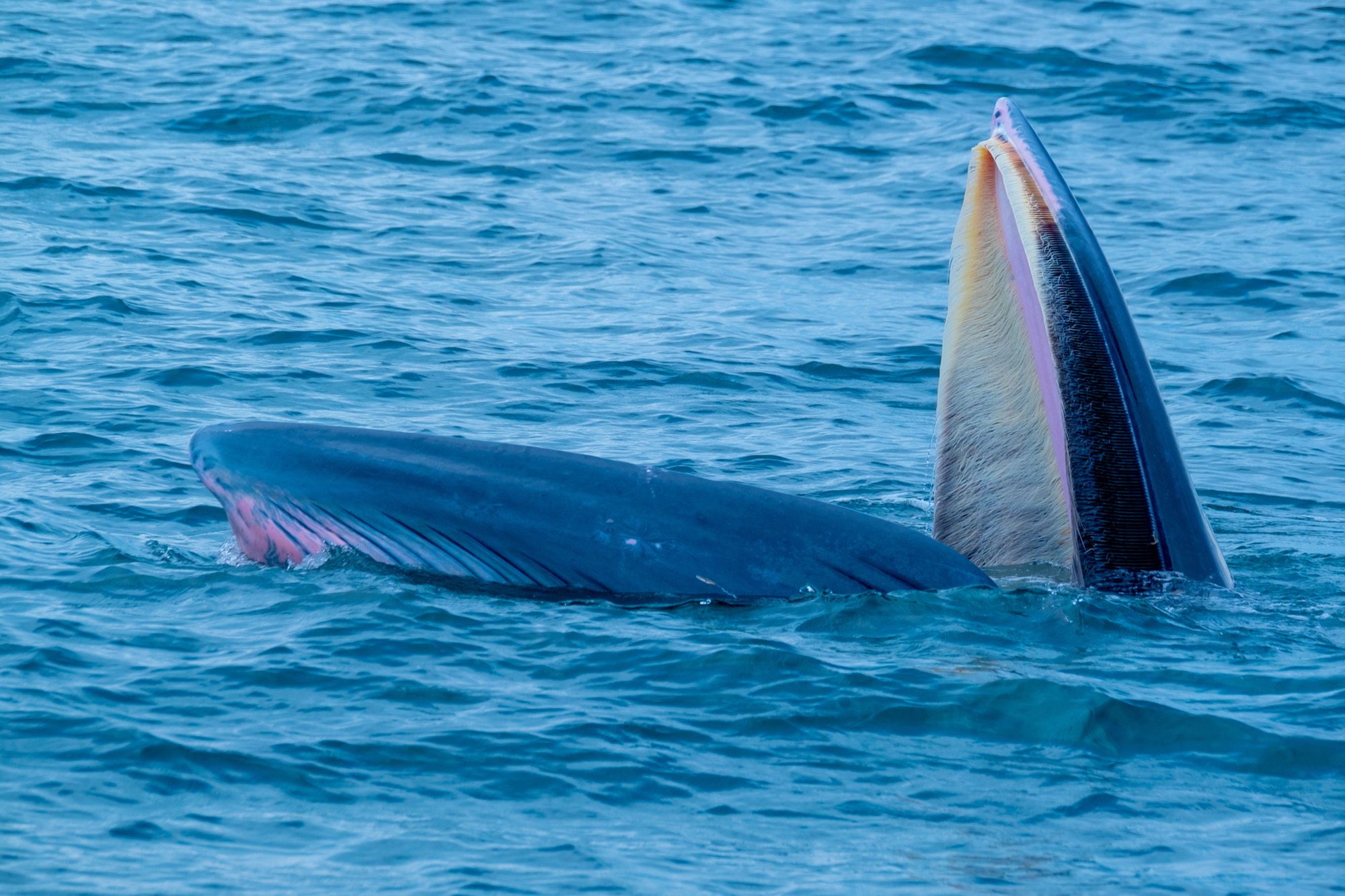
Baleen is an oral tissue that is attached to the upper mouth in baleen whales. There is no functional analogue of baleen - it is unique to baleen whales. The word “baleen” comes from the Latin balaena and means “whale”. The basic function of baleen is to filter. The whale takes in enormous amounts of water and prey. The baleen whale then closes its mouth, pushing water out using the tongue. The water is allowed to escape, while the prey gets caught in the inner hair-like edges of the baleen.
The baleen plates are made of keratin, which we know well from our hair and nails. Like hair and nails, baleen grows throughout life (about 10-31 cm/year). It grows in one rack on each side of the upper mouth in triangular plates. The outer edge is smooth. The inner edge consists of hair-like fibers that overlap with fringes on the other plates. These play a huge role in creating the mesh that actually traps the prey.
The number of plates in each rack varies greatly from species to species, but lands somewhere between 130-480. Plates are between 3-8 mm thick and are spaced about 1cm apart. The rest varies depending on the whale. For example, balaenids (bowhead whale, right whale) have long and narrow plates, whereas rorquals (humpback whale, blue whale) have shorter and wider plates.
As an example, gray whales feed on benthic crustaceans by sucking in sediment and prey. Because of this feeding style, they have evolved a coarse baleen rack of approximately 140-180 plates, about 5-25 cm each. The hair-like fringes are also very coarse.
Comparison of feeding styles
Lunge feeding
Blue whale, humpback, fin whale, sei whale
Large heads, streamlined bodies- Speed
- Fast: accelerates to ~4 m/s per lunge
- Mechanism
- Forward acceleration → jaw opens to ~80° → ventral grooves expand enormously → engulfs water and prey exceeding body volume → closes mouth → filters through baleen → swallows prey
- Prey
- KrillSmall schooling fishEuphausiids
- Baleen
- Shorter and wider than ram feeders. Ventral groove blubber allows extreme mouth expansion.
- Where
- Water column: below the prey patch, accelerating upward through it
- Pattern
- Intermittent: energetically costly, but a very high yield per lunge
Continuous ram feeding
Right whale, bowhead whale
Highly arched rostrum, thick build- Speed
- Slow: ~1 m/s with the mouth continuously open
- Mechanism
- Swims through prey patches with the mouth open. Prey and water enter through a gap in the baleen; water exits through the sides. Prey is trapped by the baleen.
- Prey
- ZooplanktonCopepodsKrill
- Baleen
- Very long (over 4 m in bowhead whales) and fine-textured, with up to 640 plates in bowheads. The baleen shape reduces the bow wave, maximising prey intake.
- Where
- At or below the surface, through dense zooplankton patches
- Pattern
- Sustained slow swimming; can feed for extended periods
Suction feeding
Gray whale
Unique to the gray whale Straight, narrow head; 2–7 throat pleats- Speed
- Slow: stationary or near-stationary
- Mechanism
- The tongue is depressed like a piston to create negative pressure, sucking prey and sediment into the mouth
- Prey
- Benthic organismsPlanktonic organismsNektonic organismsSome plant material
- Baleen
- Short (5–40 cm) and coarse, ~130–180 plates per side
- Where
- On or near the seafloor; rolls onto its right side while feeding
- Pattern
- Continuous, 24 hours a day during the feeding season
Energetics
All baleen whales have made adaptations specific to their feeding style. These are, for example, the different body shapes, baleen characteristics, and the tactics employed to catch prey. The different techniques also reflect very different requirements and energetics. It is speculated that filter feeding is more effective than the more single-prey hunting of toothed whales. The generally larger size of baleen whales could be seen as supporting this theory. There are many upsides to being this large in water, like lower energy cost of transport, but it also means that you must consume vast quantities of food. The ram feeding style of bowheads and right whales undoubtedly incurs an energetic cost, with drag potentially increasing 6 times when feeding. However, this section will focus on lunge feeding, which costs significant energy for the whales. Lunge feeding requires a lot of energy with the rapid acceleration and subsequent engulfment of water. An analysis in “The Journal of Experimental Biology”, however, suggests that the energy required for a single lunge for a blue whale is only twice as much as maintenance costs. Even though drag levels may exceed those of regular travel several times. This is likely the case because the maximum drag is only experienced for a few seconds. The acceleration phase can be done in a regular, streamlined fashion with the mouth closed. The most important factor for foraging efficiency with lunge feeding is the prey density. The same analysis showed that with the highest observed krill densities, the efficiency of blue whale dives was an order of magnitude higher than for other marine mammals. Some estimates reach even higher densities of krill than the one used in this study. This means that blue whale efficiency could be even higher!
Lunge feeding is an effective feeding strategy, as shown by the large sizes achieved by its users. It requires a lot of energy to achieve these short bursts of output. A study by Jean Potvin used computational modeling to analyze morphological and kinematic data on humpbacks, fin whales, blue whales, and minke whales. The simulations found that the energy required to lunge feed increases disproportionately with body size. The relative amount of power needed is thus higher in larger whales. It is also suggested that during the time the mouth is open, the whales have a significant oxygen deficit, which makes them reliant on anaerobic catabolism. We know anaerobic catabolism from hard workouts and the buildup of lactate. This deficit means that longer breathing breaks must be taken between dives. All this could mean that the current size of the blue whale is the limit.