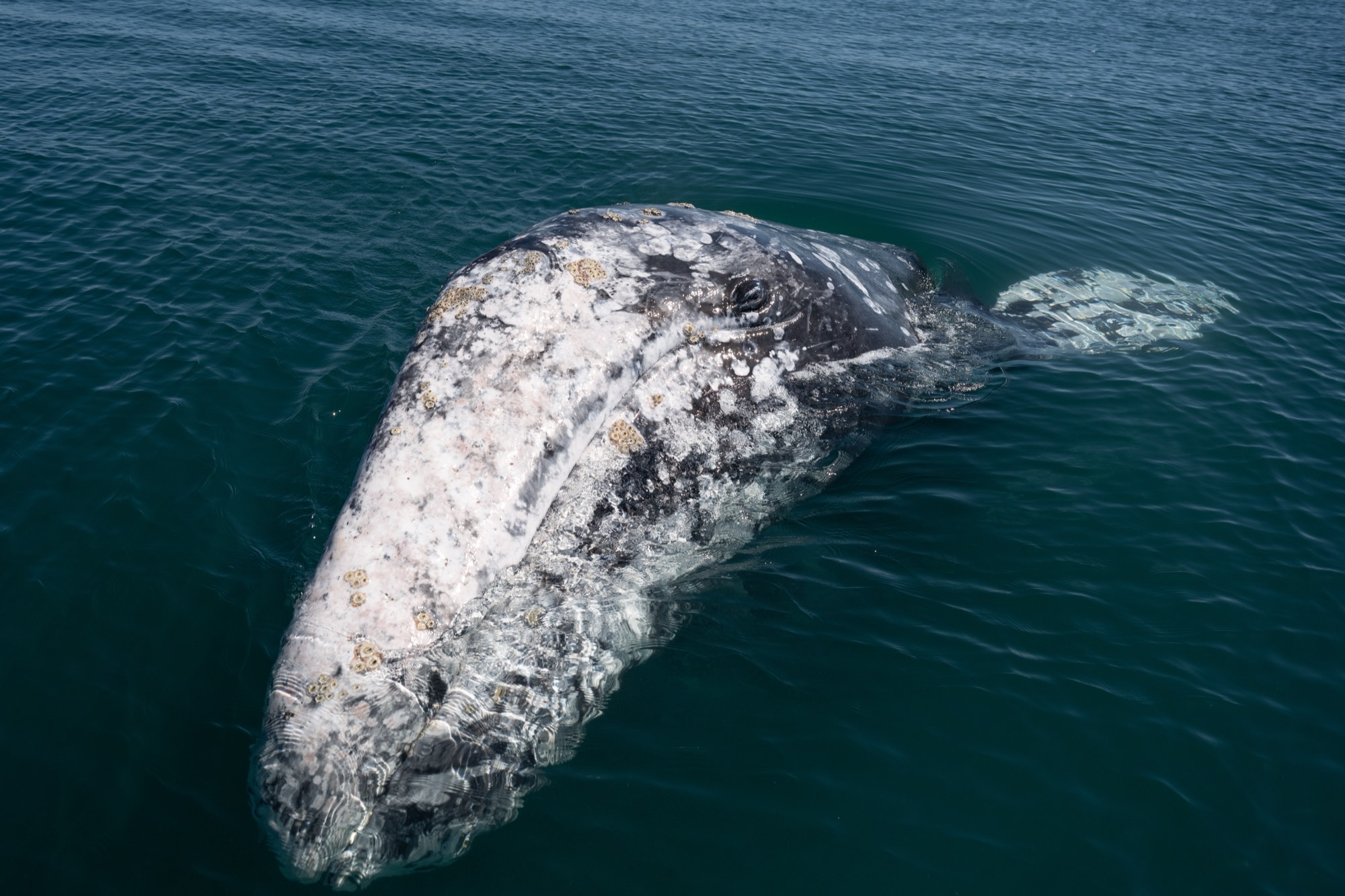
Gray whales love to breach and frequently do it on their long migrations. One gray whale even breached 40 times in a row! An impressive feat for a 36-ton whale!
Personality of gray whales
The gray whale is a stocky and slow-swimming baleen whale. Two populations exist today: the eastern North Pacific (least concern) and the western North Pacific (endangered). It used to live throughout the Northern Hemisphere, but went extinct in the Atlantic, largely due to whaling.
The killer whale is the primary predator threatening gray whales. It is estimated that about 35% of calf mortality is due to killer whale predation. It is also likely that sharks, mostly great white sharks, sometimes attack gray whales. Gray whales do not make easy targets, though. Gray whales are known to have very strong mother-calf bonds. They show great affection toward each other, and the mothers will fight fiercely, even to their deaths to protect their calf. This is also supported by whalers, who exploited the fact that gray whales refuse to leave injured companions. Whalers also called the gray whale the “devil fish” due to their relentlessness and ferocity when attacked. Gray whales will respond to attacking killer whales by either swimming towards shore and seeking protection from the shallow water, and perhaps kelp beds or actively defending by slashing their flukes at the attackers or spinning at the surface, which creates large splashes. Mothers with calves will also roll over with their calves on their stomachs at the surface, thereby lifting them out of the water and thus out of harm’s way.
Gray whales are rarely social and usually travel alone or in small transient groups. However, when they are together, when attacked, they will group up and defend each other.
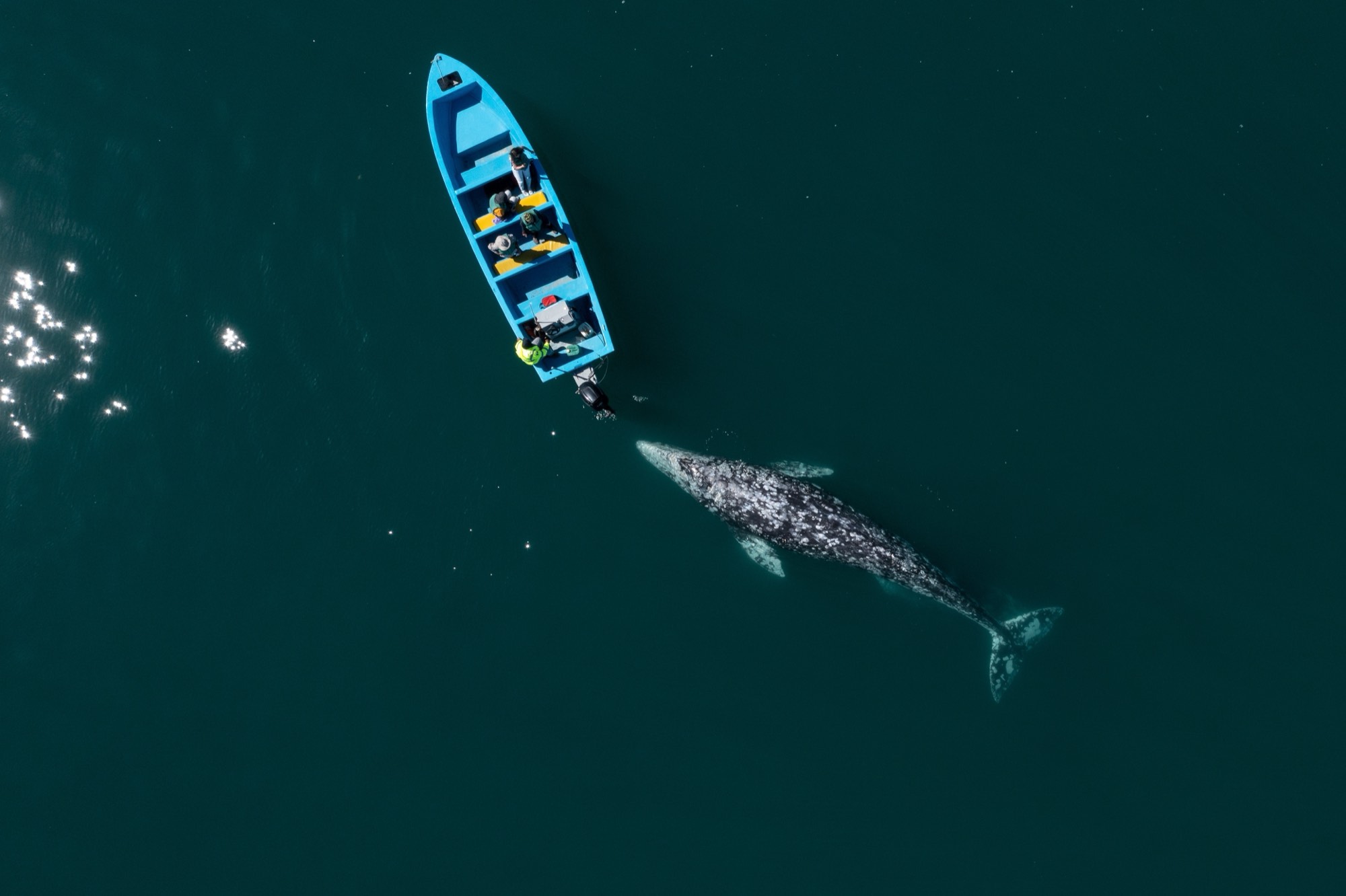
As a fun contradiction, they are also known as “the friendly whales” by whale watchers in Mexico. Gray whales are one of the more popular species among whale watchers. They are known for being curious about the boats and even letting whale watchers pet them. This perfectly displays their gentle nature if not under threat.
The great travelers
The western North Pacific (WNP) population and the eastern North Pacific (ENP) population mostly live apart, but have some spatial overlap. They likely share a wintering ground, for example. The ENP feeds in the shallow coastal waters between Alaska and Russia. They migrate annually from feeding grounds in the Arctic to breeding grounds in coastal waters in Baja, California. This is the longest annual migration of any baleen whale. Round trip, it is between 15.000-25.000km long. That covers up to 55 degrees of latitude. The trip is made in about two months and is spent on traveling and mating. When on these great migrations, they travel at about 7km/hr both day and night. Breaching is often observed during migration, which must be an incredible sight with a 15m long, 40-ton whale jumping out of the water. Why they do it is still not known. Females with calves will take breaks for nursing and rest, but generally keep up the pace. One way the mothers can help the calves is by taking the majority of the drag by having the calves assume a slipstream position.
By late December or early January, the females arrive in winter grounds in the lagoons of Baja, California, ready to give birth or for non-pregnant females to mate.
The migration northward to the feeding grounds in the Arctic is done in two phases. The first phase is of impregnated females, followed by adult males and juveniles around late January-March. They go first to maximize time spent feeding. The second phase begins a couple of months later, consisting of mostly lactating females. They stay behind for their calves to build size and strength for the long migration ahead. Mother and calf will primarily travel close to shore until reaching the summer feeding bonanza.
Feeding
Gray whales focus their feeding on the summer months they spend in highly productive waters. They fast during the migrations and on the winter breeding grounds, so they must consume large amounts of food in the summer. During winter, they will have lost up to 30% of body weight, which they will need to replenish. During summer and fall feeding time, adult gray whales will eat around 220,800 kg of food. During this time they forage constantly. The grey whale is unique in its feeding pattern. It is flexible in food preferences and eats a wide variety of benthic organisms (organisms that live on or in the ocean floor), planktonic organisms (drift in water), nektonic organisms (can actively propel themselves through water), and even some plants. Gray whales are mostly suction feeders, but also lunge and skim. They are the do-it-all of baleen whales.
Suction feeding is the third feeding technique of baleen whales. Gray whales do this by rolling to one side (almost always the right) while close to the ocean floor and sucking in prey and sediments while trapping the prey with baleen. Suction feeding is done by creating negative pressure inside the mouth to suck in the prey. The gray whale uses its strong and very mobile tongue as a piston to suck in the various benthic invertebrates. The bottom-feeding of gray whales creates large trails and “feeding pits”. This removes large quantities of invertebrate prey and resuspends sediment. Up to 36% of the feeding site sea floor is disturbed. The benthic community is heavily disrupted by this, and the removal of infaunal (living beneath the seafloor) invertebrates creates opportunities for others. One paper reports better foraging opportunities for diving sea ducks.
In addition to this, gray whales can also feed higher in the water column on krill and even fish, making them highly flexible to change.
Sound and noise
Gray whales see quite well, likely have some sense of smell, and are very sensitive to touch. Sound, however, is clearly the best option for the lives of gray whales. They use low-frequency calls that range from 100Hz to 4kHz. The low-frequency calls might be an adaptation for living in the coastal area with many higher frequency sounds like waves and currents. These relatively uninhabited frequencies are changing quickly. Much of the marinescape has changed with human-produced noise. Many human activities, like shipping, sonar, and seismic surveys, are happening in the low-frequency range. This might damage hearing, make communication harder, interfere with navigation, and prevent the detection of predators by masking sound. It can also be smaller but still consequential effects. So far, altered behavioral states, increased group cohesion and displacement have all been documented in cetaceans due to vessel encounters.
Leila S. Lemos performed a study to determine the physiological effect of vessel traffic on gray whales. She did this by collecting fecal glucocorticoid metabolite (fGC), which can be used to detect the adrenal stress response. The results showed a significant correlation between fGC and vessel counts, indicating increased stress levels in the gray whales. It also showed a correlation between vessel traffic and underwater noise levels. Together, this indicates that vessel noise is a factor of stress in the tested gray whales.
The gray whale is incredibly diverse in its choice of prey and feeding mechanisms. It is suggested by a study by Nicholas D. Pyenson and David R. Lindberg that this diversity might have saved them in the past. The primary feeding grounds of gray whales are shallow and benthic habitats in the Bering Sea. During the Pleistocene, current feeding grounds were eliminated by sea-level lows. This has happened multiple times with many ups and downs in sea level. The overall availability of their preferred feeding grounds has historically been much lower than it is today. These facts led them to conclude that gray whales would have experienced large fluctuations in population if they stuck to bottom-feeding. They further hypothesized that the survival of gray whales was due to their diverse feeding styles.
This adaptability is still present in gray whales today and inspires hope that they might survive the climate changes of today.
However, an unusual mortality event from 2018 to 2023 was linked to changes in the ecosystem in the Arctic and sub-Arctic feeding areas. This led to many malnourished whales, fewer calves born and many fatal strandings. The eastern North Pacific gray whale population fell from 20,500 in 2019 to 14,526 in 2023, and only 217 calves were counted in 2022 compared to 950 in 2018. How susceptible they are to changes in the environment therefore remains to be seen.